Waste Local Plans are supposed to help deliver the waste and recycling infrastructure Britain needs. But asking waste operators to predict their future site requirements years in advance can actually make investment slower, harder and less certain. There is a better way to plan for future waste infrastructure.
Imagine you decide you need to move house.
Perhaps your family has grown. Perhaps the children have finally left and you don’t need four bedrooms anymore. Perhaps you’ve got a new job. Perhaps you’ve simply decided that the neighbours are intolerable.
So you start looking for another house.
Then imagine a world where the next step requires you to contact the council, only to discover that you should have told them you might want to move during an eight-week consultation exercise… eleven years ago.
Welcome to waste planning.
Apparently, we’re supposed to know the future
Waste Planning Authorities have an important job. We need waste facilities, but we also need some control over where they’re built. Nobody sensible is suggesting that somebody should be able to buy a field next to a primary school and open a 200,000-tonne waste transfer station simply because they’ve found a cracking deal on Rightmove.
So councils prepare Waste Local Plans. These are supposed to assess how much waste-management capacity an area is likely to need and provide a strategic framework for where future waste development should take place. As a principle, that seems entirely reasonable.
The problem starts when strategic planning becomes an attempt to predict individual commercial decisions years before businesses are ready to make them.
During preparation of a Waste Local Plan, councils issue a ‘Call for Sites’. Landowners, developers and waste operators are invited to put forward land that might be suitable for future waste development. Again, that sounds perfectly sensible until you consider how businesses actually make decisions about property.
A waste business might need another site because it grows. Its current lease might expire. A neighbouring use might make its existing operation increasingly difficult. A competitor might close. A new customer might create demand in another part of the county. A new waste stream might emerge, or regulation might completely change the economics of processing an existing one.
Or somebody might simply knock on the owner’s door one Tuesday morning and offer them an industrial site that wasn’t available six months earlier.
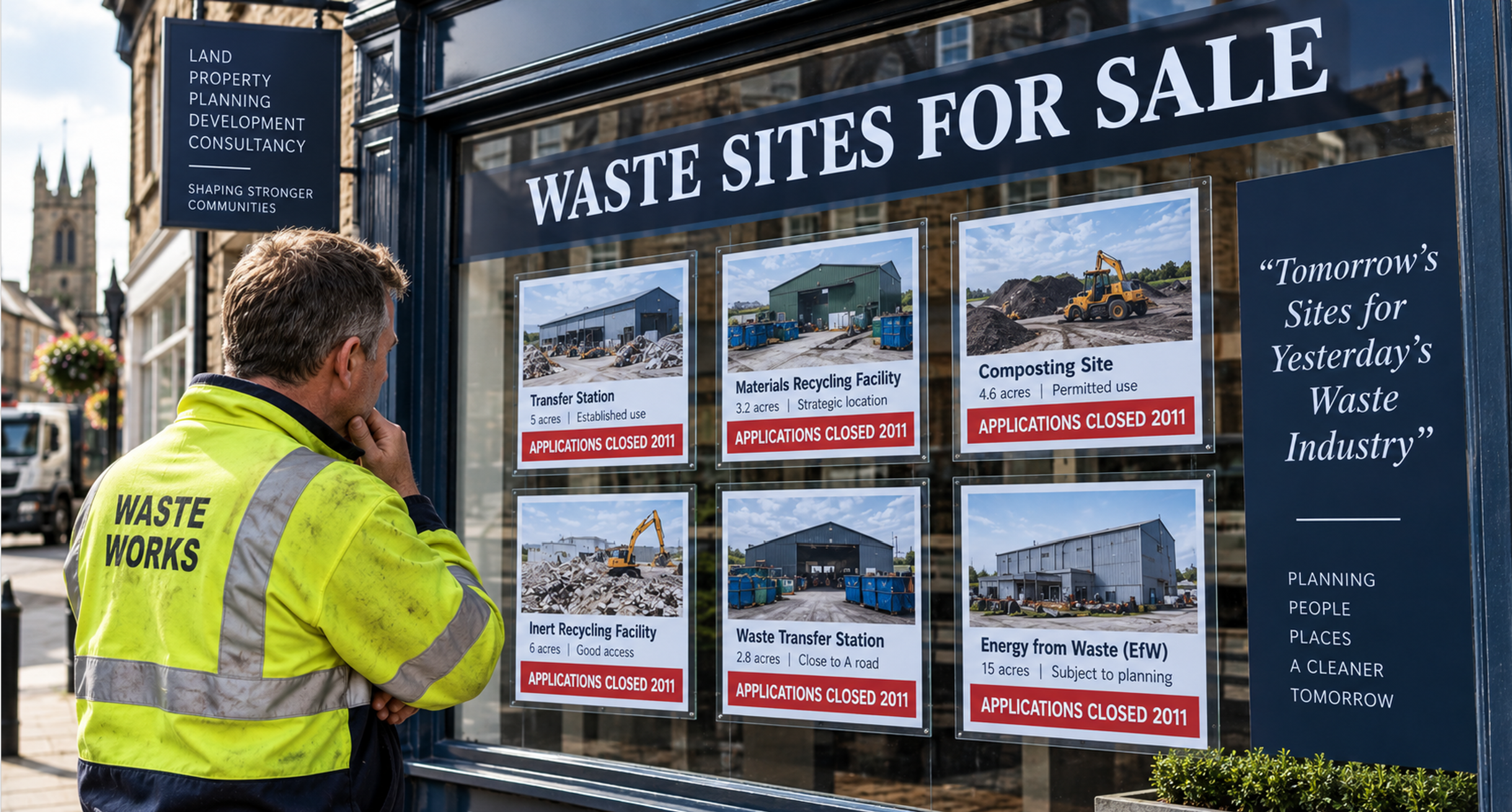
That’s how businesses work. They respond to opportunities, problems and changing markets as they arise. They don’t necessarily sit around a boardroom table in 2011 and say, ‘I reckon we’ll need another transfer station somewhere near Chelmsford in about 2026. We’d better tell the council.’
Yet that is essentially what the site-allocation process expects them to do.
There are good reasons operators don’t put sites forward
Even where an operator does have longer-term ambitions, there are perfectly rational reasons why they might not want to announce them during a Call for Sites.
The most obvious is commercial confidentiality. If I’m considering building a new processing facility in an area, why would I want to tell every competitor in the market several years before I’m ready to do it? My competitors now know roughly where I’m looking, what sort of development I’m considering and potentially something about my growth plans. Thanks very much.
There is also the slightly inconvenient possibility that the land I eventually want isn’t available yet. Businesses don’t control the property market. The ideal site might currently contain another business. It might not be for sale. Its owner might never have considered waste development. An industrial estate might not even have been built when the Call for Sites took place.
Then there’s technology. The waste industry has changed enormously over the last twenty years. Waste streams change and treatment methods change. Commodity markets change, regulation changes and technology changes with them. A facility for which there is an obvious commercial requirement today may not even have been a twinkle in the waste industry’s eye ten years ago.
Finally, the process can inadvertently favour incumbents. Large, established, often national operators have legal teams and property consultants able to provide comprehensive responses to waste planning authorities. A growing SME that doesn’t yet know it will need another site in five years’ time cannot. The result can be a planning system that inadvertently protects the existing structure of the market from future competition.
The planning system therefore asks the waste industry to predict future commercial opportunities while requiring years of evidence gathering itself because, apparently, the future is rather difficult to predict.
There’s a certain elegance to that.
Essex provides a rather good example
This isn’t a theoretical problem.
Let’s consider Essex. And I use the county as a case study because I’m familiar with it, not because ECC is any better or worse than the next waste planning authority.
Essex and Southend adopted a Waste Local Plan in 2001 covering the planning period from 1997 to 2010. Work on replacing it began in 2009. The original Plan reached the end of its intended life in 2010.
Its replacement was finally adopted in 2017.
So it took around eight years to produce a new strategic planning framework for one of the fastest-changing industrial sectors in the economy. For much of that period, the county continued operating under a Waste Local Plan whose intended planning horizon had already expired.
The replacement Plan now runs until 2032. Which means a waste operator making an investment decision in Essex today is working within a planning framework whose preparation began when Gordon Brown was Prime Minister.
The problem isn’t simply that Waste Local Plans take a long time to produce. It’s that commercial requirements can change dramatically while they’re being produced. Think about how much has happened to waste since then. Landfill tax has transformed disposal economics. RDF exports rose dramatically and then changed again. China effectively closed its doors to large quantities of recyclable material. Brexit happened. POPs regulations changed the way certain wastes are handled. Local Energy from Waste capacity expanded. Commodity markets moved violently. Battery fires became a significant operational problem. Simpler Recycling arrived. Food waste segregation is changing residual waste. Carbon policy is increasingly influencing infrastructure decisions and a UK ETS is heading towards waste incineration. Maybe.
Sorting technology has changed too, along with automation, processing equipment and the economics of recovering individual materials. Businesses have opened, closed, consolidated and changed strategy.
Yet the planning system is somehow supposed to have anticipated where the businesses responding to all of this would need to operate.
That’s not strategic planning.
That’s asking Mystic Meg to write an infrastructure policy.
Being in the Plan doesn’t even settle the argument
Perhaps all this would be easier to defend if getting a site allocated gave an operator meaningful certainty that waste development would actually be allowed there.
But it doesn’t.
A Waste Planning Authority can spend years gathering evidence, assessing potential locations, consulting residents and eventually identifying a site or area as suitable for waste development. Then, when somebody finally brings forward the actual facility the Plan was supposedly designed to facilitate, much of the argument begins again.
Residents object. Parish councils object. Local campaign groups mobilise. Councillors receive emails, and suddenly everybody discovers that they don’t particularly fancy having a waste facility nearby.
Which isn’t terribly surprising. Almost nobody does.
But surely that raises a fairly obvious question. If the authority has already gone through a strategic planning exercise to determine where waste development should happen, why is the fundamental suitability of that location effectively capable of being put back on trial when somebody finally proposes building something there?
There absolutely should be public consultation on individual waste developments. A site allocation cannot sensibly give an operator carte blanche to build whatever they like. The details matter enormously, particularly vehicle movements, operating hours, noise, dust, throughput, technology and environmental protection.
But those are questions about how a particular facility should operate.
The much bigger question of whether waste development is appropriate in that location at all should surely have been subjected to its greatest scrutiny when the Waste Local Plan was being prepared. If local people believe a particular area is fundamentally unsuitable for waste development, that is precisely when the planning system needs to hear from them.
Otherwise, what exactly has the allocation achieved?
The authority has spent years deciding where waste facilities should go, only to discover that when somebody actually proposes one, we apparently need to decide whether we want a waste facility there.
Again.
And then politics arrives
There is another uncomfortable feature of this process.
Professional planning officers assess applications against planning policy, technical evidence and the adopted development plan. They can draw upon highways advice, environmental assessments, statutory consultees and specialist expertise.
But significant applications are ultimately decided by elected councillors who require no particular expertise in waste management.
That doesn’t make councillors stupid, dishonest or incapable of making sensible decisions. Nor does it mean residents shouldn’t have a voice. But it does create an obvious tension between strategic planning and local politics.
A planning officer considering a proposal is principally asking whether it complies with policy and whether its impacts can be adequately controlled. An elected councillor may be considering those things, but they are doing so while potentially facing a room full of angry constituents who will declare quite vehemently which way they’ll vote at the next election.
At its core – in planning context – waste infrastructure is particularly vulnerable because the benefits and disadvantages are distributed very differently.
Thousands of people will, entirely unknowingly, benefit indirectly from a functioning waste facility. Councils need recycling capacity. Businesses need their waste collected. Construction companies need somewhere for material to go. Householders need skips. The economy needs somewhere to process the millions of tonnes of waste it produces every year.
But those thousands of beneficiaries aren’t normally sitting in the council chamber. It’s just the fifty people living closest to the proposed facility.
And while everybody wants their waste collected, recycled and kept out of landfill, rather fewer people volunteer to have the infrastructure required to achieve those things built near their house.
So we end up with a planning system that can spend years deciding where waste infrastructure ought to go, only for the political consequences of actually putting it there to emerge when somebody finally tries.
Where exactly are we supposed to build all this stuff?
Government wants more recycling, greater segregation of waste and less reliance on landfill. It wants food waste collected separately, more material pushed higher up the waste hierarchy, investment in better processing technology and an industry capable of responding to increasingly ambitious environmental and carbon policy.
Every one of those ambitions has an infrastructure consequence.
If we want more materials recovered, somebody has to process them. If we want waste streams separated, somebody has to receive them. If we want new technologies adopted, somebody has to build them somewhere.
That means MRFs, transfer stations, food waste facilities, bulking facilities, recycling plants, treatment facilities and technologies we probably haven’t even thought of yet.
And all of them need land. Arguably, ever larger parcels of land, as the economies of scale both public and private sector customers demand leave waste yards in which you could barely turn a rag and bone man’s horse and cart, back in the era of black and white sitcoms.
This is where waste planning stops being an obscure subject discussed by people carrying enormous lever-arch files and starts affecting whether environmental policy can actually be delivered.
Government can introduce all the waste policy it likes. It can change collection systems, increase taxes, restrict disposal routes and create financial incentives designed to push material towards supposedly better outcomes.
But if the infrastructure needed to deliver those outcomes can’t be built when the market needs it and somebody is prepared to invest in it, the material doesn’t magically disappear.
We have spent a great deal of time asking what Britain’s future waste strategy should look like. Perhaps we should spend a little more time asking whether our planning system is capable of letting anybody build it.
How should we plan future waste infrastructure?
None of this means abolishing Waste Local Plans.
There is a perfectly legitimate role for strategic waste planning. Councils need to understand how much waste their areas produce and what infrastructure is likely to be required. They need to prevent inappropriate development, protect communities and the environment, understand transport implications and safeguard strategically important waste infrastructure from incompatible neighbouring uses.
But none of that requires a council to know which individual industrial unit a waste business might want to occupy ten years from now. And pretending to know really is public sector folly at its finest.
A better system would concentrate far more heavily on identifying the characteristics and broad locations suitable for waste development, then establishing clear and robust criteria against which proposals can be assessed when they actually arise.
Tell the market where waste development is broadly acceptable. Tell operators what environmental, transport and amenity standards they will need to satisfy. Protect appropriate industrial areas from incompatible development and give meaningful weight to the strategic decision that waste uses belong there.
Then let businesses find sites when they actually need them.
In other words, perhaps finding a new waste site should be a little more like moving house.
You realise your circumstances have changed. You work out what you need. You find somewhere suitable. Then you demonstrate that what you want to do there is acceptable.
The waste industry is already being asked to invest enormous sums delivering the environmental ambitions politicians have set for it.
Expecting operators to know years in advance where those investments will need to be made is unrealistic. Then making them spend years more, and considerable sums, promoting a development, while offering remarkably little certainty that they’ll eventually be allowed to build it, is commercially debilitating and utterly infuriating.
Particularly when the very same public sector is asking why the infrastructure it says it needs isn’t being built quickly enough.
We’re not planning for the future. We’re planning the future around the past.
About Gerald Price
Gerald Price is a business change consultant and interim managing director specialising in business turnarounds, operational improvement and commercial performance, especially within the waste and recycling industry.
Having worked with operators across the sector, he regularly writes about leadership, strategy, waste policy and the commercial realities facing UK waste businesses.
More articles and insights can be found at www.gpcp.co.uk and https://www.linkedin.com/in/geraldprice/