Better business decisions don’t come from finding arguments that support what you already think. They come from challenging your assumptions, testing the obvious answer and being prepared to ask: what if the opposite were true?
I spend quite a lot of my working life telling business owners what I think of their businesses. Sometimes they even pay me for it 😉
I look at their numbers, their people, their customers and their operations. I ask lots of irritating questions. And eventually I’ll form a view about what’s going wrong and what they should do about it.
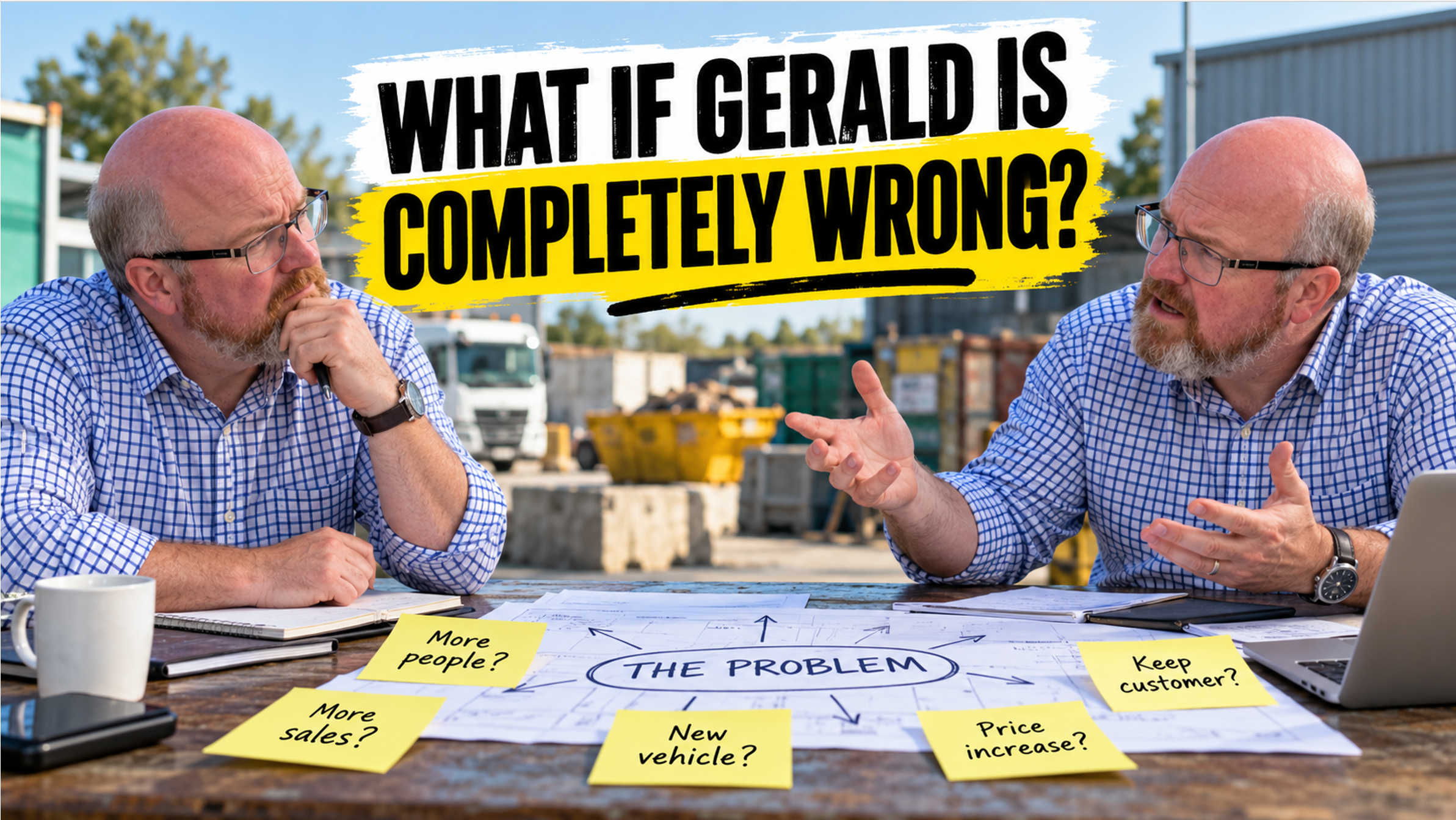
There’s just one small problem. What if Gerald is completely wrong?
Not slightly wrong. Not ‘right in principle but perhaps we should tweak the implementation.’ But completely, fundamentally, spectacularly wrong.
Because that question, actually underpins quite a useful discipline: What if the opposite of your opinion is true?
How to challenge assumptions before making a business decision
Imagine a business that’s struggling to fulfil its workload. Everyone is busy, but customers are shouting, service levels are slipping and the management team is convinced that they need more people.
Sounds reasonable, right?
But how about, before kicking off a recruitment drive, we deliberately start from the opposite position?
We already have too many people.
It could be nonsense. But spend a little time making the argument work. Look for truth within the assertion.
Perhaps we’re doing work we shouldn’t be doing. Perhaps poor scheduling is creating unnecessary activity. Perhaps we’ve designed processes which require three people where one should be enough. Perhaps managers are protecting workloads which shouldn’t exist. Perhaps people are spending their days correcting mistakes created somewhere else in the business.
Because everyone really could be extremely busy. But they’re busy doing the wrong things.
Now, we might eventually demolish all of those arguments and conclude that the original answer was right. Fine. Start recruiting.
But earn the conclusion rather than simply accepting the most obvious explanation for what you can see. Because businesses are often far too full of obvious explanations.
A business which supposedly needs more sales might discover that a significant chunk of its existing sales barely makes any money. The transport operation might discover that its problem isn’t the number of vehicles but what it’s asking them to do. The company terrified of losing its biggest customer might finally calculate how much (or little) profit that customer actually contributes.
And the business convinced that the market won’t tolerate a price increase might discover that losing some customers at the old price isn’t necessarily a disaster.
You’re not arguing the opposite because you believe it. You’re deliberately using an unreasonable proposition to force yourself into questions that the reasonable proposition never required you to ask.
That’s where this becomes more than playing Devil’s Advocate. And it’s one of the reasons I enjoy going into businesses where something isn’t working.
Often, I’ll be told upfront what the problem is. Not because people are trying to influence me, but because they’ve been living with it for months or even years. They’ve discussed it in management meetings. They’ve tried things. Eventually the explanation becomes common ground.
But I don’t have to accept the premise. And neither do you.
We can ask what happens if the opposite is true. Look for the thing that doesn’t fit the accepted explanation. Ask the irritating question that disappeared from management meetings six months ago because everybody thought it had already been answered.
And sometimes we’ll conclude that everyone was right all along. Great. Let’s put a practical and sustainable solution in place.
But sometimes the problem a business has spent months trying to solve isn’t actually the problem at all.
That’s where an outside pair of eyes can be enormously valuable. Not because the outsider is cleverer than everybody inside the business, but because they haven’t spent the last two years agreeing with things that everybody inside the firm has decided to be true.
Questioning the obvious answer doesn’t mean you have to abandon it.
You might turn a problem upside down, challenge every assumption you’ve made and still arrive back at exactly the same place.
Good. Because now there’s a difference. You haven’t simply accepted the obvious answer. You’ve tested the thinking behind it. And there’s a material difference between decisiveness and certainty.
So perhaps before a significant decision, there’s one question worth adding to the usual analysis:
What would have to be true for us to be completely wrong?
This question attacks the decision itself.
And you don’t have to believe the alternatives. You just have to be prepared to follow the argument far enough to discover whether there’s something you haven’t seen.
Maybe experience shouldn’t make us increasingly certain of our answers.
Perhaps it should make us increasingly sophisticated in the ways we try to prove them wrong.
Of course, there’s an obvious catch.
When I pull up at your site, I bring my own assumptions through the gate with me.
I’ve spent years forming opinions about how businesses should be run. Some of them are pretty strong.
So I need to be prepared to challenge those assumptions just as hard as I challenge everybody else’s.
What if Gerald is completely wrong?
Because if I can’t make a convincing case that I’m right after seriously considering that possibility, I probably shouldn’t be advising anybody else what to do.
About Gerald Price
Gerald Price is a business change consultant and interim managing director specialising in business turnarounds, operational improvement and commercial performance, especially within the waste and recycling industry.
Having worked with operators across the sector, he regularly writes about leadership, strategy, waste policy and the commercial realities facing UK waste businesses.
More articles and insights can be found at www.gpcp.co.uk and https://www.linkedin.com/in/geraldprice/