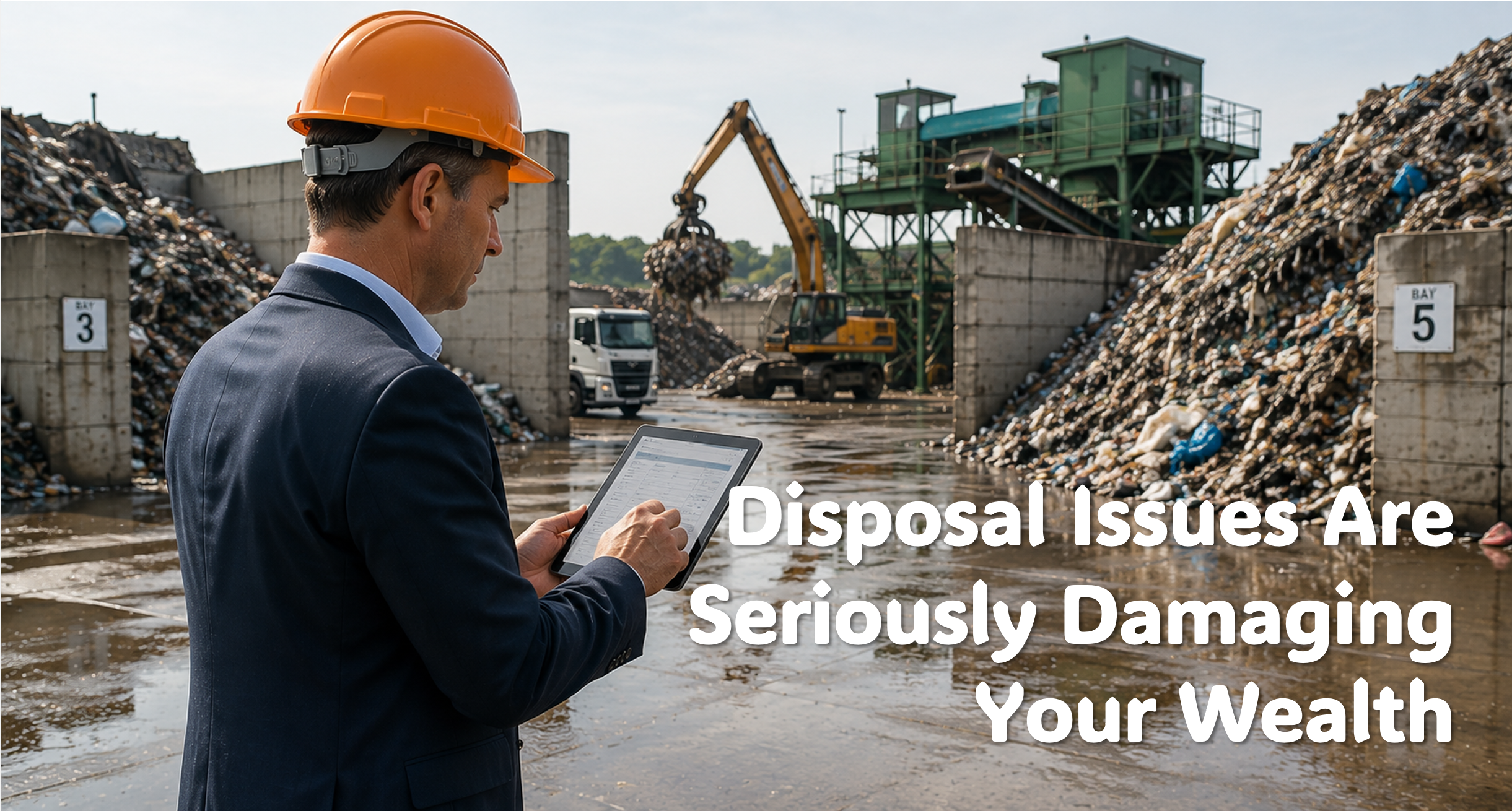
The disposal market has become a very different place.
Landfill capacity has, without warning, massively reduced. Energy from Waste (EfW) operators have, simultaneously, delivered increasingly unreliable availability, and fussier input specifications. Third-party transfer facilities are now more selective about who comes over the ‘bridge and are much more expensive. Legitimate waste businesses – SMEs especially – are spending far more time than they used to simply working out where tomorrow’s waste can go.
I’ve written quite a lot about these operational challenges over the last few weeks.
But I think there’s a much bigger issue lurking in the bottom of the skip.
These issues are changing the value of waste businesses.
Ask most waste business owners what their company is worth and the conversation will usually begin in a familiar place.
Turnover. EBITDA. Property. Plant. Fleet. Maybe some contracted work. Perhaps a multiple borrowed from the last transaction they heard about, or from a broker who has explained what businesses of that type are currently achieving.
None of that is wrong. The numbers matter, and they will always matter. But I am increasingly convinced they no longer tell the whole story.
What happens when a transfer station loses an outlet? What happens when an EfW plant tightens its acceptance criteria? What happens when a landfill closes, a permit is suspended or a previously dependable third-party transfer facility decides it no longer wants your material?
Obviously, those are serious operational questions. But they are also valuation questions.
A waste company – just like any other business – is only valuable for as long as it can continue to trade profitably. And in this sector, continued trading depends on much more than winning customers, keeping vehicles busy and processing tonnage. Every tonne that enters the business must eventually leave it again. If the routes out become unreliable, prohibitively expensive or completely unavailable, then the historic profit shown in the accounts may tell you very little about the profit the business can earn today and in future.
Two Similar Businesses Can Carry Very Different Risks
Imagine two waste businesses with broadly identical turnover and EBITDA.
They operate in similar territories. They handle similar tonnages. Their fleets are comparable and their customer bases look equally healthy.
One has several dependable disposal routes, a sensible spread of end markets and contracted access to key outlets. Its management team understands the characteristics of the waste it handles and has actively developed processing alternatives in case one route is lost.
The other relies heavily on spot pricing from a small number of third parties. It has few meaningful alternatives and produces residual waste streams that are becoming progressively harder to place.
At first glance, the accounts for these businesses may look almost identical. In practice, they are not remotely the same proposition. One has resilience. The other has exposure.
This is where historic financial performance can become deceptive. The accounts tell you what happened, likely, eighteen months to two years ago. They do not guarantee that those historic conditions will continue.
Because if a company has been earning £5 million of EBITDA while relying on a disposal route that doesn’t exist today, how secure is that £5 million?
That is not an accounting question. It is a question about the quality and durability of earnings.
Now all businesses face uncertainty. Markets change. Regulations evolve. New competitors appear. And we don’t reduce the value of a business simply because something difficult might happen ‘one day’.
But for waste, the disposal market has already changed. It’s already influencing the way legitimate operators trade. It’s already affecting gate fees, customer pricing, operational flexibility and investment decisions. And in some cases, the firm’s ability to open the gates tomorrow morning.
Once a commercial risk starts changing day-to-day trading, it stops being a hypothetical future problem. It has become integral to the business you’re valuing today.
Why Disposal Access Is Now a Strategic Asset
A business with secure outlets can quote with more confidence. Especially to major customers who only expect a price review once a year. It can make better decisions about customer mix and it is less exposed to sudden price shocks, leaving it less likely to find itself desperately ringing around the market when a route closes.
It may also be able to accept waste that others cannot safely or economically handle.
That creates value.
The difficulty is that this value sits almost entirely outside the conventional balance sheet. A contracted outlet is not a building. A trusted commercial relationship is not a piece of plant. A well-developed network of alternative routes will not appear as an asset at all.
Yet those things will determine whether the business can continue operating when the market becomes difficult. Conversely, a company with attractive historic margins but weak disposal resilience carries a hidden liability.
This does not mean a business without guaranteed outlets is worthless. That would be too simplistic. A buyer with its own infrastructure may be able to solve the problem immediately, for example. A larger group may be able to redirect material through its existing network. The weakness may even create an opportunity for the right acquirer.
But this means that the buyer is then bringing part of the value to the transaction. And that will certainly affect the price.
What Does the Processing Plant Actually Produce?
There is a second dimension to this, and it concerns the assets everyone can see.
Waste businesses often attach considerable value to treatment and sorting equipment. That is understandable: the kit may have cost millions of pounds. It may be relatively new, mechanically sound and capable of impressive throughput.
But replacement cost is not the same as economic value.
A processing plant doesn’t have value because it cost £5 million. It has value because somebody still wants what comes off the end of it.
If it produces clean, desirable recyclates and a manageable residual fraction with several available routes, the plant may be genuinely valuable. But if it produces marginal grades, heavily contaminated materials or a residual stream that fewer and fewer outlets will now accept, the position is very different.
The machinery may still be working perfectly, but the market around it may have moved on.
So if your processing line is producing outputs for a market that no longer exists, well… it’s like having the most efficient VHS production line in the world.
That does not make the engineering worthless. But it does mean the commercial value of the kit has become questionable.
This is a distinction that is easily missed, especially by people looking at the business from a distance. A valuation schedule may show the age, condition and estimated replacement cost of the equipment. It may say very little about the placeability of the products coming off the end of the operational line .
And surely that placement is the issue that matters most?
Processing plant that consistently converts difficult incoming waste into dependable, marketable outputs should command a premium. Plant that concentrates the problem into an even harder residual stream may be far less attractive than the owner believes. In some circumstances, it may even create a future capital requirement because the buyer will need to modify, replace or reconfigure it.
The asset still exists. But its economic usefulness should attract further investigation.
This Matters Whether You Are Buying, Selling or Staying Put
It would be easy to treat all of this as advice for people buying waste businesses.
It is not.
It matters to a buyer because the buyer needs to understand what sits behind the EBITDA. Are the profits resilient? Are the disposal routes secure? Are the processing assets genuinely useful? What additional capital or commercial capability will be needed after completion?
It matters to a seller because weaknesses in these areas may reduce value, extend due diligence or cause a buyer to reprice the deal. But an owner planning an exit in three or five years should not wait until the information memorandum is being written before thinking about disposal concentration or product quality.
It matters to lenders because debt is repaid from future cashflow, not historic pride and to investors because a business that appears asset-rich may be facing a large future bill to adapt those assets.
But, you may be surprised to note, it also matters to owners who have no intention of selling at all.
Because the question, “What is my business worth?” is not only about an eventual transaction. It is also an important way of asking whether your company is becoming stronger or weaker.
Is your business more resilient than it was three years ago? Does it have more options? Are its outputs easier to place? Is it less dependent on individual outlets, customers or members of staff? Are recent investments increasing strategic flexibility, or merely increasing throughput through the same vulnerable model?
I have seen plenty of waste businesses continue to grow whilst simultaneously becoming more unstable and less valuable.
They increase turnover while becoming more exposed. They buy expensive equipment while reducing adaptability. They report record profits while becoming increasingly dependent on one disposal route over which they have no control.
GROWTH and VALUE can never be assumed to go hand-in-hand.
The Accounts Are the Starting Point, Not the Answer
Traditional valuation metrics remain essential, but they are only the starting point. The more important questions are deeper inside the business context: how profits are earned, whether they are sustainable, and whether the operating model can adapt as disposal markets continue to evolve. The businesses that command the strongest valuations over the coming years are likely to be those with dependable outlets, adaptable processing and genuine strategic options.
So, what is your waste business actually worth today?
The answer may still begin with the numbers.
But ultimately, a waste business isn’t worth what it earned yesterday.
It’s worth what it’s capable of earning tomorrow.
Further Reading: Why I Think This Matters
If you’re wondering why I’ve placed so much emphasis on disposal resilience, it’s because this article is the conclusion of a line of thinking I’ve been developing over the past few weeks.
In a recent five-part LinkedIn series, I explored the UK’s shrinking disposal capacity, the growing difficulty legitimate operators face in placing certain waste streams, and why I believe disposal resilience is becoming one of the defining strategic issues facing the waste sector.
This article asks a different question.
If disposal resilience is already changing the way waste businesses operate, should it also change the way we value them?
You can read the full five-part series here:
- Part 1: The Capacity Crunch
- Part 2: When Legitimate Businesses Run Out of Options
- Part 3: What Behaviour Does the System Encourage?
- Part 4: Are We Making Criminals More Competitive?
- Part 5: What Is the UK’s Waste Strategy?
About Gerald Price
Gerald Price is a business change consultant and interim managing director specialising in business turnarounds, operational improvement and commercial performance, especially within the waste and recycling industry.
Having worked with operators across the sector, he regularly writes about leadership, strategy, waste policy and the commercial realities facing UK waste businesses.
More articles and insights can be found at www.gpcp.co.uk and https://www.linkedin.com/in/geraldprice/