Why waste processing plants should be designed around their outputs, not their inputs
Waste processing plants should be designed around the quality, commercial value and available markets for their outputs, rather than simply the volume of waste entering the facility. Working backwards from the required products helps determine the most appropriate sorting processes, equipment and investment.
There’s something about spending a multi-million-pound sum on a new waste processing plant that makes people go weak at the knees. It reinforces the knowledge that they’ve moved up a tier in the waste company hierarchy.
Conveyors, shredders, screens, magnets, air separators, optical sorters. Hundreds of tonnes of machinery, all working together to turn mixed waste into neat piles of supposedly recyclable materials.
It’s impressive stuff. And I can understand why waste company owners are attracted to it.
But in preparing to make such an investment, I do wonder whether the wrong questions are being asked at the design stage. The salesman will talk animatedly about throughput, recovery rates, automation, labour savings and the sophistication of the technology.
All perfectly reasonable considerations.
But over the last few months, the performance of the various disposal markets has seen me suggest that we start with a factor that’s rather less glamorous.
Who’s going to take the stuff that comes out of the back end?
And what condition do they want it in?
Because unless we can answer those questions, I’m convinced we have no business choosing the machinery that goes at the front.
Sorting isn’t recycling
Separating materials doesn’t automatically make them recyclable.
You can extract wood, plastics, aggregates, fines and various other fractions from a mixed waste stream. You can put them in separate bays, give them reassuring names and record impressive recovery percentages.
But if nobody wants those materials, or the only available outlet charges a fortune to accept them, what exactly have you achieved? Worst case, all you’ve done, is spend money creating several piles… out of one.
And potentially made the business less profitable in the process.
The market for recovered materials has changed. Outlets that once accepted certain grades may now demand cleaner, more consistent products. Some materials that previously had value have become liabilities, while new markets have emerged without fanfare.
So why are we still designing processing operations around what we can extract, rather than what somebody actually wants to receive?
The destination should determine the product.
The product should determine the process.
And the process should determine the machinery.
Not the other way round.
Why does everything need shredding?
This is where I start scratching my head.
Look at many of the sophisticated mixed C&D waste processing plants installed in recent years and you’ll find they start with a shredder.
Waste arrives in a skip, gets tipped onto the floor, and a grab feeds it into the machine. Everything gets chopped up.
Wood, plastics, cardboard, rubble, plasterboard, insulation, metals. Materials that were previously large enough to identify and separate become smaller pieces of a much more complicated mixture. Because shredding isn’t a perfect science. Set a machine to produce material around 300mm and you don’t get uniformly sized pieces. You get a mixture ranging from large fragments right down to tiny particles and dust.
Now, I’m not suggesting shredders don’t have a place in waste processing. Of course they do. But surely we should first ask what actually needs shredding?
Take a large piece of timber. If it can be grabbed out of the tipped waste and sent to an appropriate wood recycling outlet, what commercial benefit comes from automatically chopping it into little pieces first? What if the gate fee for untreated wood is lower?
Or half a skip of bricks in a mixed load. Why put additional wear on an expensive shredder when it could potentially have been screened out beforehand?
And what about plasterboard, insulation and other materials capable of contaminating downstream outputs?
Break them into small fragments and you’ve potentially made the job of producing clean recyclable materials considerably harder. Qualifying Fines are tough enough an aspiration without paying a fortune to deliberately contaminate them.
We pay to reduce everything’s size, pay to separate it all, yet may just have damaged the quality of the materials we’re trying to recover.
That’s a peculiar definition of efficiency.
The most valuable material might be the stuff you don’t shred
My view of mixed C&D processing is relatively straightforward. The last thing I want is to pay a substantial EfW or landfill gate fee to dispose of material that could have been separated cheaply. And I certainly don’t want to spend money shredding it first.
One method is to start with people or a 360-degree grab to remove the obvious materials.
Large pieces of metal, timber and cardboard are the bare minimum. A good operation could also extract bulky plastics, tonne bags, insulation offcuts and anything else that either has a viable recovery route or threatens the quality of subsequent outputs. This isn’t sophisticated. It’s knowing what you’re looking at and understanding what it’s worth. And this approach also provides another opportunity to identify waste you don’t want anywhere near a shredder: cans of paint, batteries, gas canisters etc.
Then I’d want to remove as much of the heavy inert fraction as practicable.
Bricks, stones, rubble and suitable mineral fines are heavy. A wash plant may give them a commercial value, but even without, if they meet the specification of an appropriate outlet, their disposal cost can be negligible.
So using a screening system capable of separating much of the inert material before the remaining waste reaches a shredder could make considerably more commercial sense. The screened fraction can bypass the shredder and rejoin the processing line downstream for further separation.
That doesn’t mean everything passing through the screen is clean inert material. Further separation may still be necessary. But it does mean the shredder isn’t being asked to process every tonne arriving at the depot.
Less unnecessary shredding – the shredder is often a throughput bottleneck. And potentially less wear, less energy consumption and less contamination of downstream outputs.
Which all sounds rather more sensible to me.
The expensive bit comes next
Once you’ve removed the obvious recoverables, the problematic contaminants and much of the inert fraction, you’re left with a more challenging mixture. Which leaves you a decision to make:
Is there enough recoverable value in that remaining material to justify further mechanical processing?
That depends on what customers are delivering to the site, the available outlets, the quality of the products we can realistically produce and the cost of achieving that quality.
At some depots, further investment in mechanical separation will make excellent commercial sense. At others, it might be cheaper to accept that we’ve extracted the economically recoverable materials and send the balance directly to a suitable residual waste outlet.
And I don’t regard that as failure.
The objective isn’t to process every last tonne through every available machine. It’s to extract the greatest sustainable commercial value from the waste we receive.
There will be circumstances where sophisticated machinery genuinely earns its keep. There will also be circumstances where another £1 million of equipment merely creates another £1 million of capital employed, with insufficient additional return.
The skill is knowing the difference.
What happens to the quality?
This is the part of the shredder-first approach that troubles me most.
We tend to judge waste processing plants by how much material they recover. But recovery percentages tell us remarkably little about the commercial value of what comes out. The quality of those outputs determines who will accept them, what they’ll pay, or what we’ll have to pay to get rid of them.
If shredding breaks recyclable materials into fragments that become contaminated or difficult to separate, we may lose value that was available before processing began.
If it introduces plastics, timber, gypsum or other contaminants into the fines, we may turn an inexpensive inert output into something considerably more expensive to dispose of.
And if recyclable materials that could have been recovered whole end up as small fragments in the residual stream, we’ve paid to destroy their recoverability and must then pay again to dispose of them at a far higher rate.
Even the residual waste needs to be considered as an output with a customer.
EfW facilities and other disposal outlets have specifications and commercial preferences. A residual stream that is suitable for one destination may be less attractive to another. So a processing line can be highly efficient at moving and separating material while simultaneously damaging the commercial quality of what it produces.
This means that a processing plant can be extremely efficient at processing waste and remarkably inefficient at making money.
Who designed the business?
I do wonder whether some of the problem arises from the way major processing investments are approached.
An equipment supplier naturally wants to demonstrate what its machinery can achieve: Throughput. Automation. Separation technology. Recovery performance.
And there’s nothing inherently wrong with that. But the supplier’s engineering objectives and the waste company’s commercial objectives aren’t necessarily the same thing.
I appreciate that size reduction can be essential for certain separation technologies. But that doesn’t mean every material needs to be shredded before those technologies can do their job. In fact, some materials simply shouldn’t pass along the sorting line at all.
So a shredder-first system might be an excellent engineering solution to the manufacturer’s problem.. while being a poor commercial solution to the waste company’s problem.
That’s not an accusation against manufacturers. It’s a reminder that the operator needs to define the commercial requirements before asking anyone to design the plant.
What materials do we receive? What products can we sell? What specifications must we meet? What does each output cost to produce? What happens to the material nobody wants?
Only then should we be deciding how many screens, shredders, conveyors and separators we need.
Otherwise, there’s a danger of buying a magnificent machine and subsequently organising the business around keeping it fed.
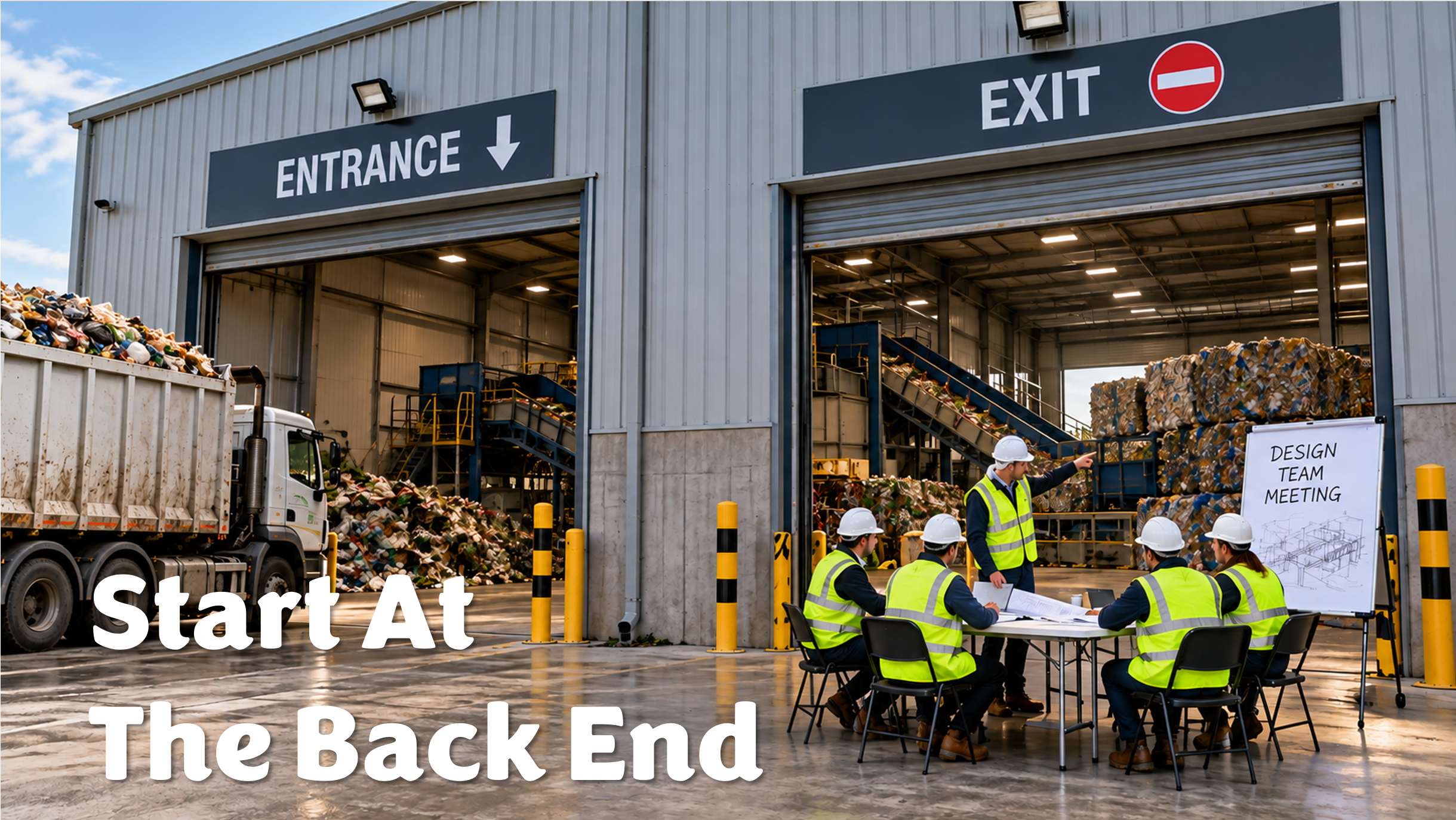
Start at the back end
I approach waste processing from a business performance perspective, rather than an engineering one. My interest isn’t in how sophisticated the machinery is, but whether the investment delivers the best commercial outcome. And I certainly wouldn’t claim that every shredder-first installation is wrong. Different waste streams, site constraints and output requirements can justify different configurations.
But I would expect anyone proposing a multimillion-pound investment in processing capacity to demonstrate why the chosen sequence delivers the best commercial outcome, not simply the greatest throughput or headline recovery rate. I would want to know the expected quality and value of every significant output, the cost of producing it, and where it’s going.
More keenly, I’d want to understand what happens when those markets change. What flexibility does the solution offer?
Because a £5 million processing plant is a very expensive way of discovering that the materials it produces aren’t what the market wants.
So start with the destination. Work backwards to the outputs. Design the process around producing them. Then buy the machinery.
Or, to put it rather less delicately:
Start at the back end to avoid being handed your arse.
Frequently asked questions
How should a waste processing plant be designed?
Waste processing plant design should begin with the materials the business intends to recover, the quality required by customers and the available disposal routes for residual waste. These requirements should inform the sorting process and machinery selection.
Should mixed construction waste be shredded before sorting?
Not necessarily. Shredding mixed construction and demolition waste before removing valuable or problematic materials can increase contamination, equipment wear and processing costs. Pre-sorting and screening may be commercially preferable, depending on the waste composition and required outputs.
Does a higher recycling recovery rate mean a more profitable waste processing plant?
No. Recovery rates alone do not establish profitability. Material quality, achievable selling prices, processing costs and the cost of disposing of residual waste all influence commercial performance.
Why does output quality matter in waste recycling?
Recovered materials need to meet the specifications of their intended markets. Poorly separated or contaminated materials may attract lower prices, require additional treatment or incur disposal costs rather than generate revenue.
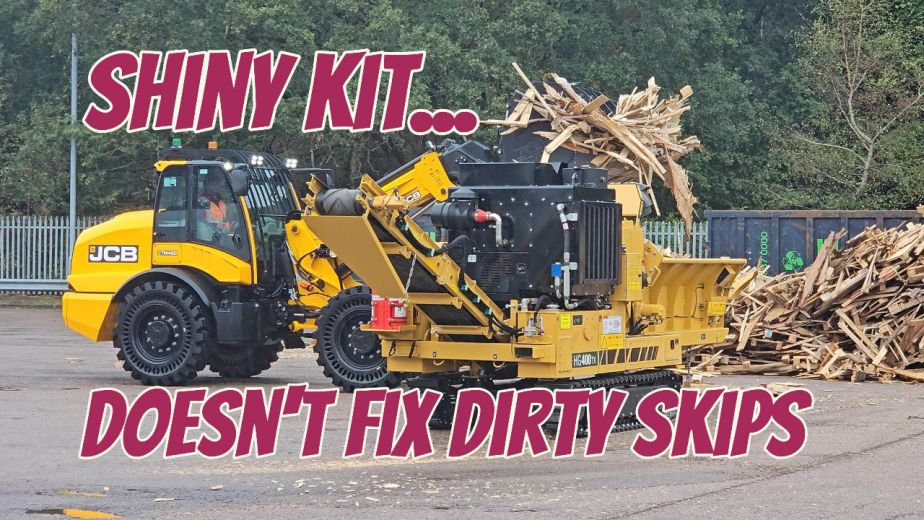
I’ve previously explored how the desire to own impressive machinery can distort investment decisions.
About Gerald Price
Gerald Price is a business change consultant and interim managing director specialising in business turnarounds, operational improvement and commercial performance, especially within the waste and recycling industry.
Having worked with operators across the sector, he regularly writes about leadership, strategy, waste policy and the commercial realities facing UK waste businesses.
More articles and insights can be found at www.gpcp.co.uk and https://www.linkedin.com/in/geraldprice/