Why the Waste Industry Has a FOMO Problem
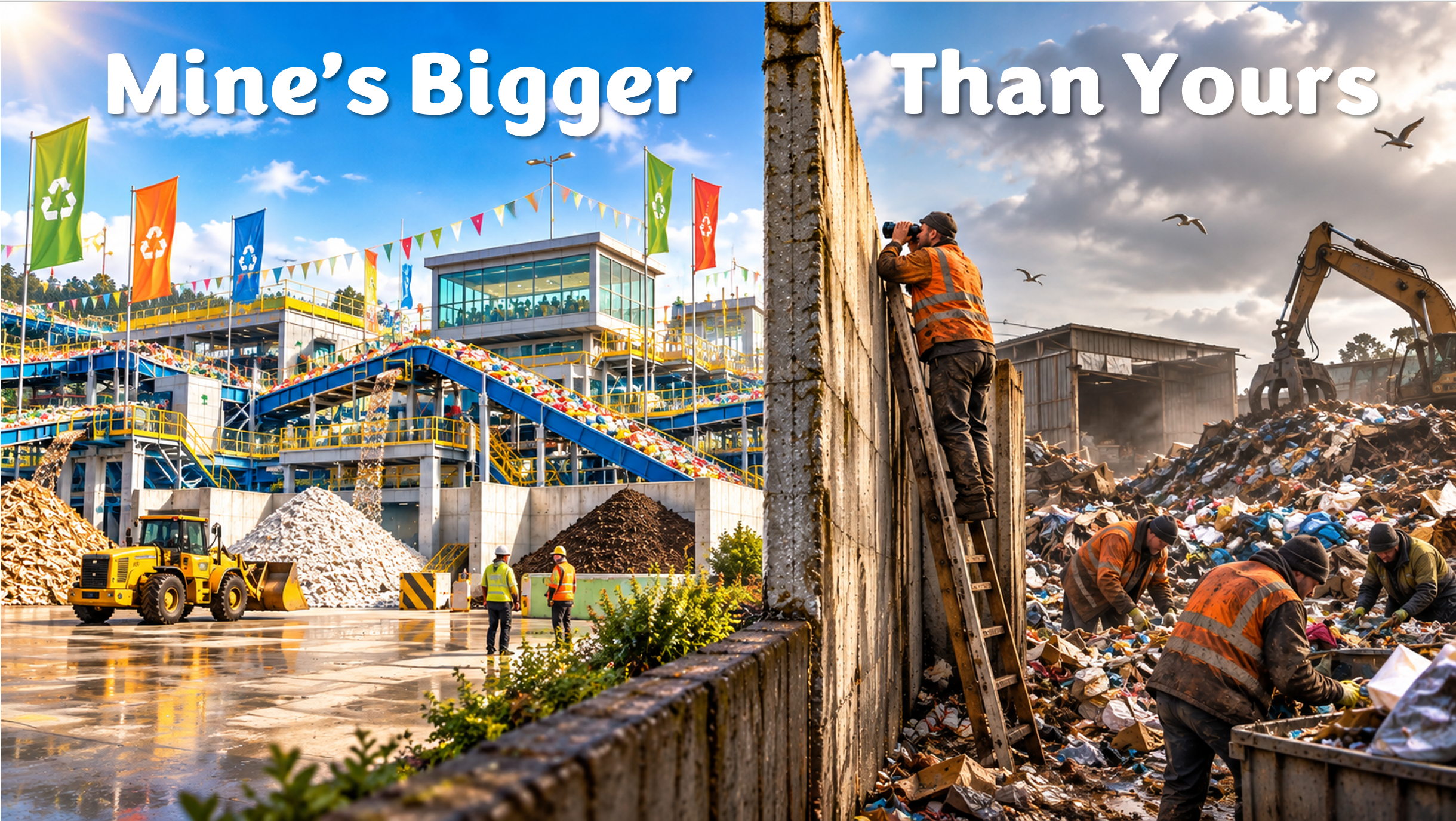
Mine’s Bigger Than Yours examines the psychology behind major investment decisions, and how the idea of owning expensive machinery can subsequently distort a business leader’s commercial behaviour.
There’s a particular form of keeping up with the Joneses that seems alive and well in the waste industry. And it doesn’t involve having a bigger house, a newer Range Rover or a more expensive holiday than your competitors.
It involves processing machinery.
Your competitor up the road has just installed a shiny new multi-million pound processing line. It’s impressive. There are conveyors everywhere, sophisticated sorting technologies and a control room that looks like it could launch a space shuttle.
And suddenly, the perfectly serviceable operation you’ve been running for years starts looking a little inadequate.
Perhaps you need one too? In fact, never mind need – you WANT one! There’s no way you’re going to let the next firm steal a march on you!
Don’t let the bandwagon leave without you
With destructively mixed metaphors in hand, I’m increasingly convinced that some of the waste industry’s investment in processing machinery is driven as much by FOMO, the fear of missing out, as it is by sound commercial reasoning.
Nobody wants to be the operator who gets left behind. Nobody wants to admit at the next industry event that they’re still sorting waste the old-fashioned way while everyone else is talking about their latest multi-million-pound investment.
And there’s no shortage of machinery suppliers happy to speak effusively about how their products will beckon a bright new dawn that will transform your business.
But there’s something rather important that you can’t see when you visit your competitor’s impressive new facility.
Whether it’s actually making them any money.
You can admire the machinery, watch the tonnes flying through it and marvel at the recycling percentages. But you don’t get to see the maintenance bills, the finance payments, or the true cost of disposing of whatever comes out the other end.
You’re seeing the investment, not necessarily the return.
Why More Waste Processing Capacity Doesn’t Always Mean More Profit
The really dangerous part comes after the investment.
Because capital investment changes the economics of a waste business. And, sometimes, it changes management behaviour too.
A processing line costing millions needs to justify its existence. There are financing commitments to meet, machinery to maintain, energy to consume and people to operate it. And those costs don’t disappear because the yard has a quiet Tuesday.
So the business needs feedstock. More tonnes. More revenue. More material passing through the shiny new machinery. And if the existing customer base isn’t providing enough, the pressure starts building. The machinery finance payments keep leaving the bank account, and there’s still a payroll to meet.
Suddenly, you’re collecting from further away. You’re less disciplined about pricing. You’re accepting material you previously wouldn’t have touched. Not because any of it has become more profitable, but because you desperately need the cash coming in.
The question gradually changes from: ‘Is this tonne worth having?’
to: ‘How do we keep the plant fed?’
And that’s a dangerous place for a waste business to find itself.
An investment that was supposed to improve profitability can end up creating a relentless demand for volume, regardless of whether that additional volume is actually profitable.
Start at the other end
Before investing in new waste processing machinery, the commercial case should establish more than the number of tonnes it can process. What will it cost per tonne? What market exists for the outputs, at what quality and value? What will happen to residual disposal costs? And, crucially, will the investment improve gross profit after accounting for the additional operating costs?
I’m not arguing against investment in processing technology. Quite the opposite. Good machinery, designed around the requirements of the market and the direction of regulation, can transform a waste business.
But too often a ‘business case’ is simply the bag the owner brings his sandwiches to work in.
The starting point shouldn’t be what your competitor has bought, or what the machinery salesman wants to sell you. It should be the materials you can produce, the quality you can achieve, the markets available for those outputs and the margins you can realistically earn.
Work backwards from there.
Because a machine that processes more tonnes isn’t necessarily a machine that makes more money. And a glowing recycling percentage will always be a pretty poor substitute for a healthy gross margin.
So before spending £4 million trying to become the company up the road, wouldn’t it be worth finding out whether the company up the road is actually making any money?
And ask yourself: if they hadn’t bought one, would you still want yours?
About Gerald Price
Gerald Price is a business change consultant and interim managing director specialising in business turnarounds, operational improvement and commercial performance, especially within the waste and recycling industry.
Having worked with operators across the sector, he regularly writes about leadership, strategy, waste policy and the commercial realities facing UK waste businesses.
More articles and insights can be found at www.gpcp.co.uk and https://www.linkedin.com/in/geraldprice/