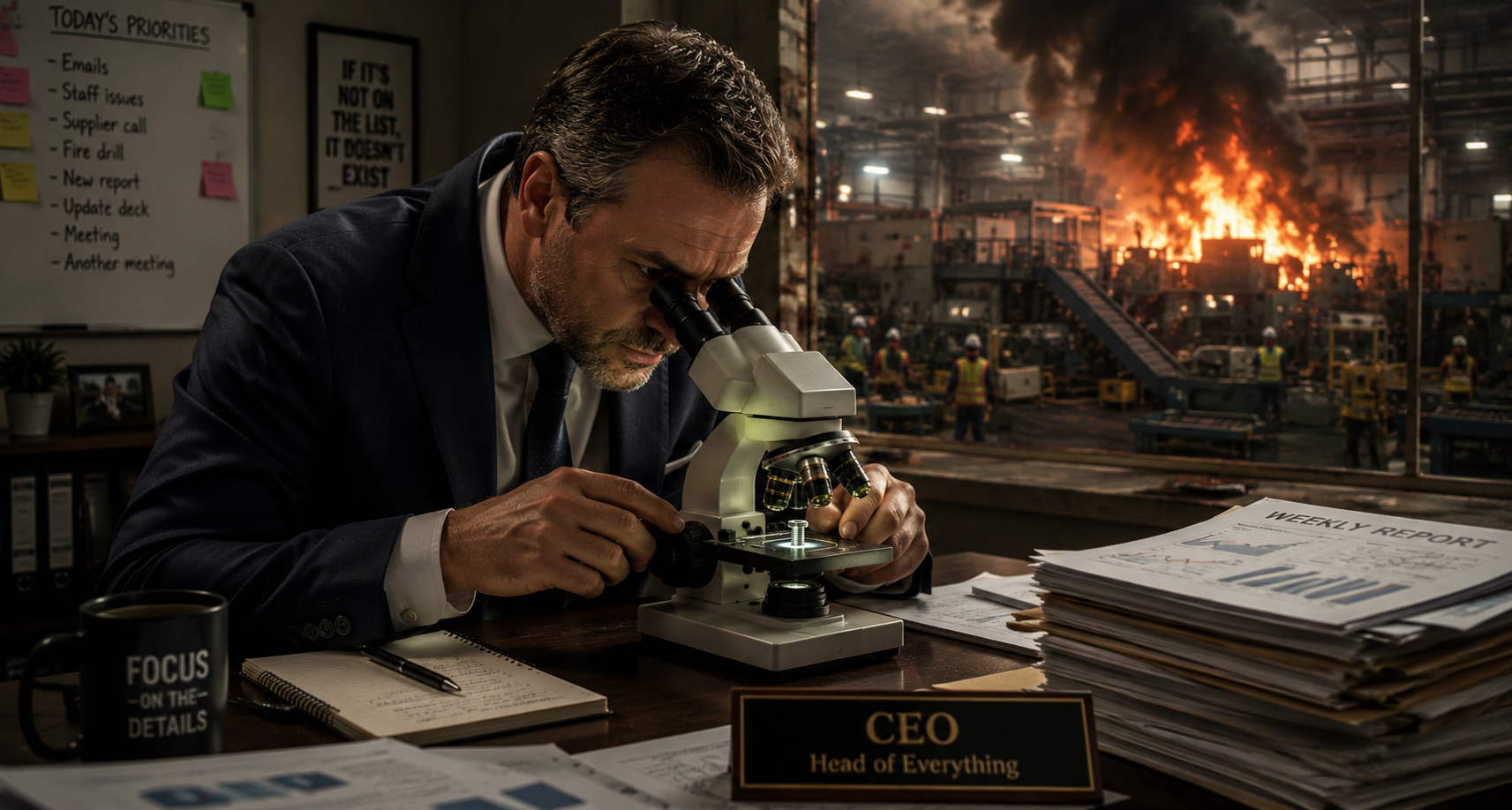
There is a curious inconsistency in the way business leaders think about expertise.
Most wouldn’t dream of drafting a complex service agreement without a solicitor. Nor would they tackle a difficult tax issue before speaking to an accountant, or spend days trying to repair a server that an IT specialist could fix in an hour. Sensible leaders recognise that specialist problems require specialist knowledge.
Yet when the problem is the business itself, many suddenly become determined to solve it alone.
Somewhere along the way, we’ve created the idea that capable leaders should instinctively know how to fix declining performance, deteriorating culture, falling margins or strategic drift, simply because they happen to be in charge. Bringing in another pair of eyes can feel like an admission that they’ve somehow failed.
It’s an odd belief because it ignores a simple truth:
The hardest part of fixing a business is often not knowing what to do.
It’s seeing the problem clearly in the first place.
That sounds absurd. After all, who could possibly understand a business better than the person who built it or has spent years running it?
The answer, quite often, is someone standing just outside it.
Experience can become a blindfold
We tend to think of experience as something that sharpens judgement. Usually it does. But experience also changes the way we see the world.
The longer you’ve lived with a business, the more difficult it becomes to separate today’s reality from yesterday’s success. Every important decision carries history with it. Products aren’t simply products; they’re the services that paid the mortgage twenty years ago. Long-serving employees aren’t just colleagues; they’re people who’ve stood beside you through recessions, difficult customers and sleepless nights. Processes aren’t merely habits; they’re the way things have always been done because, once upon a time, they worked.
None of this makes a leader irrational.
It makes them human.
I’ve worked with businesses where the central problem wasn’t poor leadership at all. The owners were intelligent, hardworking and deeply committed to their companies. They cared enormously.
And that was precisely the difficulty.
They had become so emotionally invested that they could no longer distinguish between protecting the business and protecting the version of the business they remembered.
Which are not always the same thing.
Markets move on without asking our permission. Customers change. Competitors appear. Technology and legislation quietly rewrite the rules. Businesses that thrive are usually the ones willing to evolve before circumstances force them to.
Unfortunately, recognising that moment from the inside is remarkably difficult.
You’re too close to the painting
There is an old observation that you cannot properly appreciate a painting with your nose pressed against the canvas.
Businesses are much the same.
Senior leaders spend every day surrounded by operational detail. They hear every complaint, every rumour, every customer issue, every staffing problem and every financial concern. Ironically, having access to more information can make it harder to identify what actually matters. Everything begins to feel equally urgent.
Patterns disappear beneath proximity.
That’s one reason struggling organisations often spend months tackling symptoms while the underlying problem quietly grows stronger.
A company introduces another report because communication feels poor.
It buys another piece of software because productivity has slipped.
It restructures departments because accountability appears unclear.
Sometimes those decisions help.
But quite often they’re treating the organisational equivalent of a headache while ignoring the infection causing it.
The real challenge is diagnosis, not treatment.
And diagnosis becomes extraordinarily difficult when you’re emotionally invested in the outcome.
Nobody expects this anywhere else
Every profession seems to understand the value of independent judgement.
Elite athletes employ coaches despite spending more hours on the training ground than anyone else.
Surgeons discuss difficult cases with colleagues.
Authors have editors.
Even experienced therapists have supervisors who challenge their thinking and help them avoid blind spots.
Nobody interprets this as weakness. We recognise that expertise and objectivity are different things.
Business leadership somehow escaped this logic.
Owners are expected to steer strategy, motivate people, manage risk, oversee finances, navigate changing markets and, at the same time, remain perfectly objective about their own decisions.
That expectation is impossible.
And the longer someone has carried responsibility for a business, the less realistic it becomes.
The ego nobody talks about
When people hear the word “ego”, they often picture the loud, swaggering executive who believes they’re always right.
In reality, the more common form of ego is much quieter.
It’s the internal voice that whispers, “You should be able to sort this yourself.”
It’s the reluctance to ask someone else to look under the bonnet because they might discover something you’ve missed.
It’s the fear that colleagues, customers or fellow directors will conclude you’ve somehow lost control.
Ironically, that fear often delays exactly the conversations that would prevent a problem becoming serious.
I’ve never thought less of a leader because they admitted they needed another perspective.
I have, however, seen capable leaders spend months convincing themselves that next quarter will be better, that sales will recover, that standards will improve, or that one more initiative will finally turn things around.
Occasionally they’re right.
More often they’re simply buying time because confronting reality is emotionally expensive.
Good leaders seek challenge before they need rescue
One of the misconceptions surrounding outside advice is that it only becomes relevant when a business is already in trouble.
The best leaders behave very differently.
They invite challenge while they still have choices.
They encourage awkward questions before circumstances ask them instead.
They recognise that independent judgement is most valuable when there is still time to act, not when every option has narrowed to one.
Much of that work happens quietly.
Some businesses prefer complete confidentiality. Others ask for non-disclosure agreements. Many simply want thoughtful conversations behind closed doors, with no announcements, no case studies and certainly no triumphant LinkedIn posts.
That’s perfectly understandable.
The point isn’t who knows help was sought.
The point is whether the business benefits from it.
The strongest leaders I’ve worked with all shared one characteristic.
And it wasn’t extraordinary intelligence or endless confidence.
It was the humility to recognise that every leader, however capable, eventually becomes too close to their own business.
Knowing when that moment has arrived isn’t a weakness.
It may be one of the most important leadership skills of all.
About Gerald Price
Gerald Price is a business change consultant and interim managing director specialising in business turnarounds, operational improvement and commercial performance, especially within the waste and recycling industry.
Having worked with operators across the sector, he regularly writes about leadership, strategy, waste policy and the commercial realities facing UK waste businesses.
More articles and insights can be found at www.gpcp.co.uk and https://www.linkedin.com/in/geraldprice/