Every waste company has a website. Nearly every waste company is probably quite proud of theirs. And rarely does a week go by without a waste firm announcing to the world through social media that they’ve forked out on a shiny, new one.
Yet spend an hour looking around the websites of skip hire and waste management companies and something strange starts to happen. They quickly begin to merge into a copy/paste world of familiarity.
Let’s play waste website bingo.
Family-owned. Decades of experience. Modern fleet. Excellent customer service. Competitive prices. State-of-the-art facilities. Environmentally responsible. Zero to landfill. Fully licensed.
Got a full house yet?
None of those things is necessarily untrue. The problem is that very little of it gives a prospective customer a compelling reason to choose one waste company over another.
That’s because most waste company websites are very good at describing the business.
They’re considerably less good at selling it.
Your customer isn’t as interested in you as you are
This sounds harsh, but I think it’s an important place to start.
A prospective customer isn’t visiting your website because they’ve suddenly developed an interest in the history of your waste company. They’ve arrived because they have a problem which needs solving.
That might be a householder renovating a kitchen who hasn’t got the faintest idea what size skip they need. It might be a construction manager who needs reliable collections across several sites and can’t afford containers sitting full for three days. It might be someone running a manufacturing facility who wants advice on reducing waste costs without creating operational headaches. Or it could be the procurement manager of a major company considering whether your company should make the shortlist for a substantial waste contract.
These people have completely different requirements, levels of knowledge and reasons for visiting. Yet remarkably often, they all arrive at broadly the same place.
About Us. Our Services. Our Fleet. Our Facilities. Contact Us.
That’s a website organised around the waste company rather than around the people buying from it. And that’s the fundamental mistake.
A company naturally sees itself through its organisational structure. We have skip hire. We offer trade waste collections. We accept hazardous waste. We’re optimised for recycling. We have a transfer station for third parties. We have our own fleet.
So those things become the structure of the website.
Customers don’t necessarily think like that. They think about the building project they’ve got to finish, the overflowing bins at twelve branches, the recycling target they’re missing or the waste contract that’s costing too much money.
The website describes what the supplier has. The customer is trying to work out whether any of it solves their problem.
Nobody buys your £6 million MRF
Waste businesses are understandably proud of what they’ve built. Some have invested millions of pounds in processing facilities, vehicles, depots, containers and technology. Those investments genuinely matter and they absolutely belong on the website.
But there’s a difference between telling me what you own and explaining why I should value it.
Imagine a company has invested £6 million in a sophisticated Materials Recovery Facility. The website proudly announces:
“We own and operate a £6 million state-of-the-art MRF.”
That’s impressive. But, as a customer, why should I care?
That’s not intended to be flippant. It’s the commercial question that hasn’t been answered. The MRF is a feature of the waste company’s business. The customer needs to understand the benefit it provides to theirs.
Compare that statement with:
“Because we operate our own local processing facility, we retain greater control over where your waste goes, how it is sorted and can provide greater transparency about how your recycling performance is reported.”
Same plant. Same investment. Same company.Completely different proposition.
A buyer is saying to themselves: “Now I’m beginning to understand why owning that facility might matter to me.”
The same problem appears everywhere. A waste company tells me it has its own fleet but doesn’t explain whether that gives it greater control over collections. It tells me it operates several depots without explaining whether that provides greater resilience or faster response. It tells me it has been family-owned for 40 years, but not whether that means decisions can be made quickly, relationships last longer or customers can speak directly to someone with the authority to sort a problem out.
Even “family owned”, one of the industry’s favourite descriptions, isn’t intrinsically a customer benefit.
Some family businesses are superb. Some are dreadful; parents and siblings mired in in-fighting.
The ownership structure only becomes relevant when the company explains what difference it makes to the experience of doing business with them.
So features matter. But simply listing them leaves the prospective customer to work out why they matter. A good website should do that work for them.
Excellent. Reliable. Sustainable. Says who?
Then there are the claims.
Excellent customer service. Reliable collections. Industry-leading recycling. Sustainable solutions. Professional service. Competitive pricing.
Waste company websites are awash with adjectives.
The problem with adjectives is that they’re very easy to buy. In fact, they’re free. Your worst competitor can put “excellent customer service” on their homepage tomorrow morning and suddenly they’re apparently every bit as excellent as you are.
I have yet to encounter a company proudly advertising its distinctly average customer service.
If reliability is genuinely one of your strengths, I’d much rather you proved it. Tell me what percentage of scheduled collections you complete successfully. If customers stay with you for years, tell me how long. If your recycling performance really is exceptional, show me the evidence. If you’ve helped a manufacturer reduce its waste costs by 18 per cent while improving recycling performance, tell me that story.
A believable fact will nearly always do more selling than an enthusiastic adjective.
And this matters particularly in waste because so many companies make essentially the same claims. Once everybody is “reliable”, “sustainable”, “professional” and “customer-focused”, those words cease to differentiate anybody.
Look at the website from the pavement
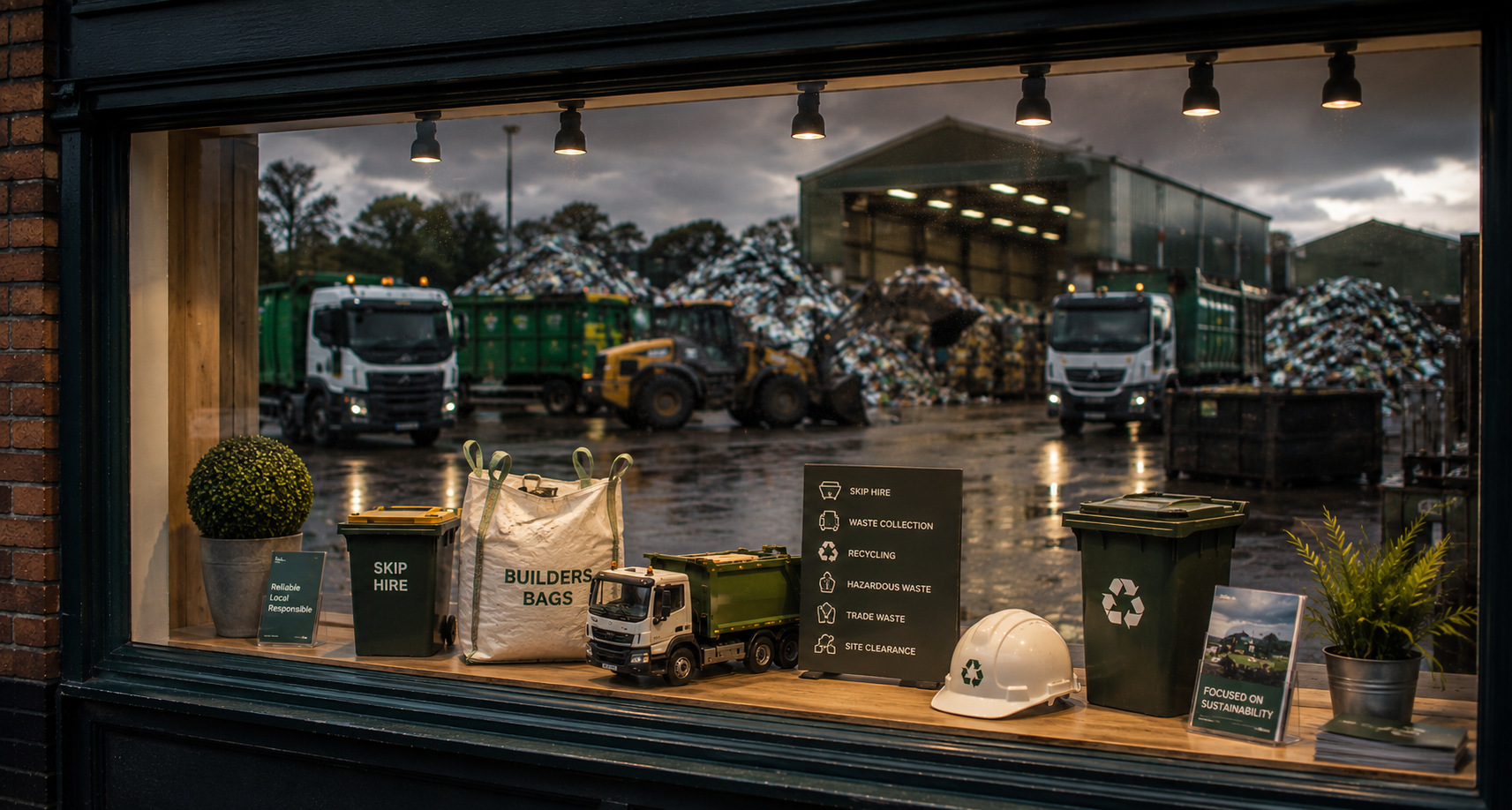
Perhaps this is where my shop window analogy becomes useful.
Imagine your website as the front window of a traditional shop. The gateway to your business sitting behind the glass. Back where the real investment has been made. The people, vehicles, plant, knowledge, systems, experience and operational capability that might have taken decades and millions of pounds to build.
But the prospective customer is still standing outside.
What have you chosen to put in the window? Too often, we’ve filled it with things we’re proud of rather than things that make someone want to come inside.
The distinction matters because customers don’t experience the whole business when they first encounter it. They experience the representation of the business that we’ve chosen to give them.
And I don’t think this requires some revolutionary approach to website design. It requires business leaders to look at what they’re presenting from the customer’s side of the glass.
A visitor shouldn’t have to investigate your website to establish whether your business is for them. A householder, construction manager or manufacturing business should be able to recognise themselves, and the problem you can solve for them, almost immediately.
In practice, a construction company should quickly see that you understand construction waste rather than simply discovering that you hire skips. Someone responsible for twenty retail locations should see how you would manage the complexity of multi-site servicing. For a factory or manufacturer, you’ll need to demonstrate an understanding of production waste, compliance, reporting and cost reduction. And a householder who has never hired a skip before… well, how have you made the process reassuringly simple?
Those aren’t really website questions. They’re commercial questions which you own the answers to.
Perhaps we’re buying websites wrongly
At some point, somebody decides the company needs a new website.
Perhaps the existing one looks tired. A competitor has just launched something much smarter. It doesn’t work particularly well on mobile phones. Google seems to have fallen out of love with it. Or perhaps everyone is simply embarrassed by something that was built eight years ago and has been patched up ever since.
Whatever the trigger, the next step seems obvious.
Find somebody who builds websites.
And I think this is where the problems often begin.
Because the company starts looking for someone to provide a solution before it has properly defined the problem.
I can completely understand why business owners and directors hand so much responsibility to website agencies. Most people running waste companies aren’t remotely interested in becoming experts in website design, SEO, user experience or any of the technology sitting behind it. Nor should they be. They’ve got businesses to run.
So they appoint specialists. Nothing wrong with that. The problem begins when outsourcing the technical expertise quietly turns into outsourcing the thinking.
The conversation effectively becomes: “We want a new website. You’re the experts. Tell us what we need.”
At that point, the agency isn’t merely being asked to design and build the website. It’s increasingly being asked to decide what the website is supposed to achieve.
And that’s a very different responsibility.
A website agency will naturally approach the problem through the things it understands. Design, search rankings, traffic, page speed, keywords, user journeys, conversion rates and calls to action may all enter the conversation. Depending on the agency, paid advertising, content creation and social media might quickly appear too.
There’s nothing inherently wrong with any of those things. A good agency should know vastly more about them than the average waste company director.
But none of them answers the most important question:
What does the business actually need this website to do?
It should come as no shock that the website agency doesn’t possess the information needed to answer that question.
The waste company does.
The agency doesn’t know which customers are genuinely profitable and which generate plenty of turnover but precious little margin. It doesn’t know why some customers stay for ten years while others disappear after a month. It doesn’t know that the sales team would dearly love more enquiries from a particular sector but could happily live without another particular type of customer. It doesn’t know which services have spare capacity, where operational constraints are beginning to bite or which apparently attractive work creates disproportionate grief for the people actually delivering it.
It also doesn’t hear the questions customers ask every day.
The people answering your phones do. The sales team does. The drivers probably do. So do the people dealing with complaints, missed collections, contaminated loads, invoices and service changes.
Collectively, the business already possesses an enormous amount of information about how customers behave, what they struggle with and what makes them buy.
Yet when the website project starts, much of that knowledge remains inside the business while everyone discusses colours, photographs, page layouts and Google.
That’s backwards.
Before anybody starts deciding what the new website should look like, the leadership team needs to understand what it wants the website to change.
Perhaps the business wants more of a particular kind of customer. Perhaps too much expensive staff time is being consumed processing simple skip orders that customers could perfectly well complete themselves online. Perhaps the company wants to move into larger commercial contracts but its current website makes it look like a backstreet skip operator. Perhaps the problem isn’t attracting more enquiries at all, but attracting better ones.
Those are business decisions. The website comes afterwards.
Nobody would buy a waste plant like this
Imagine commissioning a new waste processing facility using the same approach.
You wouldn’t ring a plant manufacturer and say: “Our current setup is looking a bit tired. We’d like something modern and impressive. You’re the experts, so tell us what we need.”
At least, I sincerely hope you wouldn’t.
Before anyone started designing the plant, you’d need to understand what was going into it and what you wanted to come out of it. You’d think about volumes, material composition, throughput, recovery, quality, available space and the markets for the outputs. You’d know which constraints the new facility needed to overcome and what commercial improvement justified the investment.
Only then would you expect the technical specialists to start designing the solution.
And you’d expect them to challenge you.
They might tell you that your assumptions about throughput are unrealistic. They might suggest different technology. They might identify a constraint you hadn’t considered or propose a better way of achieving the output you need.
That’s what good specialists do.
But they can only apply their expertise properly because you’ve first explained what the business needs the plant to achieve. So why should commissioning a website be fundamentally different?
A web designer may understand user experience, but only you understand your customers. The agency can help turn that understanding into an excellent digital experience, but it can’t invent the understanding itself.
The designer should know how to build the journey. The business should understand where the customer needs to go.
So instead of asking an agency: “What do you think our website needs?”, perhaps the conversation should be:
“This is where our business is going. These are the customers we want to attract. This is how they buy. These are the things that currently create friction. And this is what we need the new website to achieve.”
Now ask them what they would do.
A good agency should relish that conversation. And an agency which has just about mastered changing colours on a WordPress template will quickly reveal themselves to not be up to the job.
You don’t need to understand coding. You don’t need to understand the finer points of Google. You don’t need to know how to design a website. You just need to understand your business.
Then you can say:
“This is what our business needs the website to achieve. Show us how you would do it.”
That’s a very different way to buy a website.
“We don’t really get much business through our website”
This is another objection I hear from owners of established waste businesses, often accompanied by an indifferent shrug.
It’s understandable. Plenty of waste companies have grown through reputation, recommendations, relationships and good old-fashioned face-to-face sales activity. Their customers haven’t necessarily arrived through Google, selected a service, entered their credit card details and become a neatly measurable website conversion.
But I’d challenge this thinking in two ways.
Firstly, I’m not convinced most businesses really know how much influence their website has on new business.
Imagine you’ve been given the names of three local waste companies that might be suitable for your business. Perhaps another business owner recommended them, you saw their vehicles locally or somebody in procurement produced a shortlist.
What are you likely to do before contacting any of them?
I’d suggest there’s a pretty good chance you’ll Google them. You’ll look at their websites, see what they do, get a sense of their scale and professionalism, and try to establish whether they’d understand a business like yours. You’ll probably form impressions about all three before you’ve spoken to anybody.
Then you pick up the telephone. And how does that enquiry get recorded? Probably as a telephone enquiry.
Yet the website may have played a significant part in deciding which telephone number got called. It may even have decided which two numbers didn’t.
And the opposite is even harder to measure.
A prospective customer visits the website, can’t find the information they need, isn’t convinced by what they see and disappears. Nobody at the waste company knows that opportunity ever existed. There isn’t a lost-enquiry report showing that a £200,000-a-year prospect visited at 10.42 on Tuesday morning, spent four minutes trying to work out whether you could manage waste across its fifteen locations and eventually gave up.
It simply vanished.
So I’d be wary of concluding that a website doesn’t generate much business simply because relatively few orders arrived neatly labelled “website”.
A website can create value without generating a single new customer
The majority of business owners and leaders still seem to view websites through the language of marketing.
Visitors. Enquiries. Conversions. Rankings. Leads. Sales.
All perfectly reasonable measures, but they encourage us to think about the website primarily as something sitting at the front of the business trying to drag more customers through the door.
What about the work happening behind it?
Think about the routine enquiries arriving in the average waste company’s office every day. Customers want to know which skip they need, what can go in it, whether you cover their postcode, when their bin will be emptied, whether they can arrange an exchange or where they can find a copy of a particular document.
There’s nothing wrong with customers asking questions and I’m certainly not advocating the increasingly common corporate obsession with making it impossible for a customer to speak to a human being.
But there is a difference between providing excellent human support and paying people to repeatedly perform administrative tasks that don’t require human judgement.
If a member of staff spends ten minutes answering a routine question which could have been answered instantly and more conveniently through the website, there is a cost to the business. If somebody receives an email requesting an exchange, replies to clarify the site, checks the date, enters the request into another system and then emails the customer back to confirm it, there is a cost to that too.
Multiply those interactions across hundreds of customers and thousands of transactions, and suddenly we’re not talking about website design.
We’re talking about operational efficiency.
Why does the website stop working when the customer signs up?
I don’t mean it crashes. I mean it sits back and relaxes.
This is perhaps the part of waste company websites I find most perplexing.
A lot of effort, via all manner of business channels, goes into attracting prospective customers. We explain our services, show them pictures of our vehicles, provide contact forms and encourage them to ask for a quotation. Often, the website works extremely hard as part of this effort, right up until the moment the prospect becomes a customer.
Then, remarkably often, it becomes almost irrelevant to them. Why?
If I’m responsible for waste across twelve branches of a regional business, my relationship with my waste company doesn’t end when I sign the contract. That’s when it starts.
Over the following months and years I may need to change collection frequencies, request additional services, arrange a skip at one location, deal with a bulky waste requirement at another, check whether something can be collected, review service history, find documentation or obtain recycling information for a management report.
In many businesses, every one of those requirements starts with an email or telephone call.
But imagine instead that I can log into my account and see all twelve of my sites. I can see the services at each one, request an additional collection, arrange something new, find the documents I need and understand what’s happening across my estate without having to work out who I need to contact every time.
Now the website is doing something much more interesting.
It’s no longer merely telling me that you provide total waste management. It’s actually allowing me to manage my waste.
And while that’s clearly better for me as a customer, it should be better for the waste company too. Routine requests can arrive in a consistent form, with the correct customer, site and service already identified. Information doesn’t have to be copied out of emails or deciphered from telephone messages. It doesn’t matter if their account manager is on holiday or in a meeting. Employees can spend more of their time dealing with the exceptions, problems and relationships where their experience and judgement genuinely add value.
That’s not replacing customer service with technology. It’s using technology to make customer service better.
Convenience is a competitive advantage
There’s another reason I think this matters, particularly in B2B waste.
Much of what waste companies sell is difficult to differentiate. One 1,100-litre bin looks remarkably like another. Competitors often operate similar vehicles, use some of the same disposal facilities and provide broadly comparable services. The commercial conversation can therefore slide rather quickly towards price.
But the experience of buying and managing those services can be very different.
If one supplier requires me to send emails, chase responses, request reports and telephone whenever I want to change something, while another gives me a simple way to manage routine requirements across all my locations, that convenience has value.
The person responsible for waste at a restaurant chain, manufacturer or construction business probably doesn’t wake up each morning excited about spending more of their day managing waste suppliers. It’s just one of the things they need to get done.
Make it easier and you’ve created a reason to choose you. Continue making it easier and you’ve created a reason to stay.
That’s where a good website stops being a marketing expense and starts becoming part of the customer proposition.
It also changes the economics of growth.
As a waste company grows, the administrative burden tends to grow with it. More customers create more orders, more queries, more documents, more service changes, more telephone calls and more emails. Traditionally, each growth stage means putting another desk in the office and employing another person to cope with it.
Yet a website that allows customers to do more for themselves can change that relationship. It can help the business grow without administrative effort growing at exactly the same rate. That’s scalability.
Make humans do the work that needs humans. Let technology deal with the repetitive stuff.
Which brings us to an even bigger question.
Google has changed. AI has changed. Has your website?
For a long time, the relationship between a company website and Google seemed reasonably straightforward.
Someone wanted a skip in Nottingham, typed “skip hire Nottingham” into Google and was presented with a list of companies prepared to provide one. An entire industry consequently developed around helping businesses appear as high up that list as possible.
SEO became part of the standard website conversation. Keywords were researched, pages were optimised, backlinks were accumulated and monthly reports arrived showing whether the company had moved from position seven to position five for whichever search terms everyone had agreed mattered.
None of that has suddenly become irrelevant. Despite some of the more excitable claims being made about AI, Google itself says that the established fundamentals of SEO still apply to its AI search features.
But something much more fundamental is changing.
Increasingly, people aren’t only using the internet to find a website. They’re using it to find an answer.
That might still happen through Google’s AI features, or through ChatGPT, Claude, Copilot or one of the growing number of other AI services people are beginning to use as research tools.
And that creates a rather different challenge for the company behind the website.
For years, the objective was largely to persuade a search engine that your page deserved to appear when somebody typed particular words into a box. Increasingly, the challenge is also to persuade intelligent systems that your business possesses information worth using when somebody asks a question.
And that’s not really an SEO question. It’s a question of authority.
What does your business actually know?
This is where I think waste businesses have an enormous opportunity, because they contain vast amounts of knowledge that rarely appears on their websites.
Think about what an established waste company actually knows.
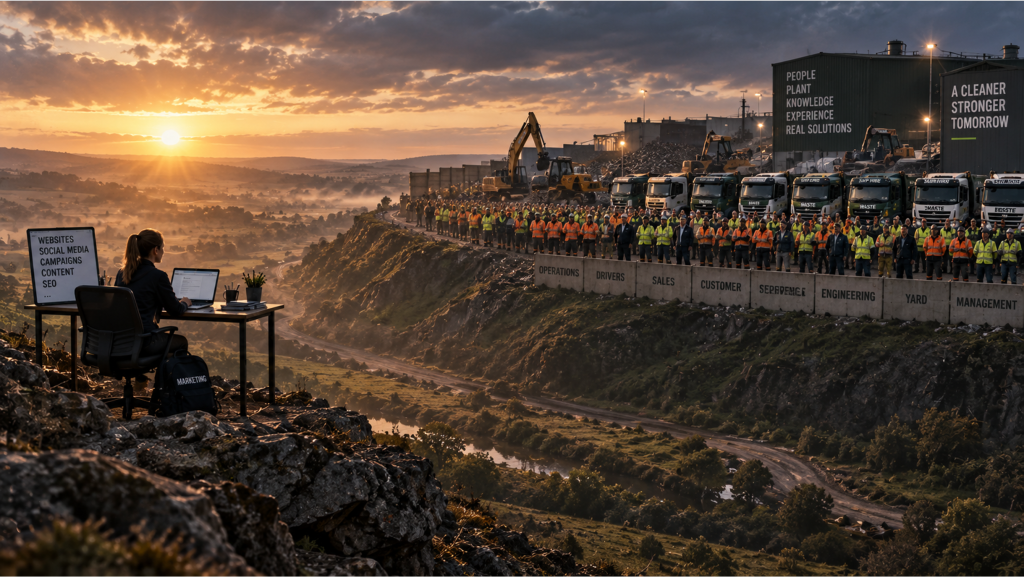
Its people understand waste streams, contamination, collection systems, processing, recycling, legislation, permits, disposal routes, vehicle access, container selection, reporting and dozens of other things that customers routinely struggle to understand. They’ve probably solved thousands of practical waste problems over the years and learned an enormous amount from doing so.
Then look at the website.
“We are a leading waste management company providing sustainable solutions to businesses across the region.”
What happened to all the knowledge?
Somewhere inside that company might be an operations manager who understands exactly why a particular waste stream repeatedly causes problems for customers in manufacturing. There may be a truck driver who could explain more about designing an efficient collection arrangement across a difficult site than almost anybody else in the business. The people running the MRF know what contamination looks like when it actually arrives on the floor rather than when it’s discussed in a sustainability policy. The sales team knows the questions customers ask before signing a contract and the customer service team certainly knows what they become confused about once the service has commenced.
That’s expertise.
And increasingly, both traditional search engines and AI systems are looking for useful, original and credible information when deciding what to show people.
Which makes me wonder why so many waste businesses are sitting on decades of genuine experience while publishing so little of it.
“Merry Christmas from everyone at…”
The News section of many websites is perhaps the clearest example.
I’m being slightly cruel here because there’s absolutely nothing wrong with telling people you’ve bought some new vehicles, sponsored a local football club, raised money for charity or wished everybody a happy Christmas. Those things show personality and community involvement, and there are perfectly good reasons for sharing them.
But is that really the most useful knowledge your business has to offer?
A company might have spent thirty years learning how to manage construction waste and yet have nothing on its website explaining the waste challenges construction customers actually encounter. It may process tens of thousands of tonnes of material every year without ever explaining what happens to those materials. It may have helped a manufacturer substantially improve its recycling performance without ever documenting what changed or what other businesses could learn from it.
Instead, the News page tells me that Sharon from Accounts completed the London Marathon. Well done, Sharon.
But we’ve rather missed an opportunity.
A good company website should increasingly become a repository for what the business knows. That doesn’t mean producing endless generic blogs, too often these days churned out unchecked by AI, because somebody has told you Google likes fresh content.
In fact, that’s almost the opposite of what I’m suggesting.
It means publishing things because you genuinely have something useful to say.
Become useful enough to cite
I think “citable” is going to become an increasingly important word when businesses think about online content.
Imagine somebody asks an AI system a reasonably sophisticated question about waste. Perhaps they want to understand why a particular material is difficult to recycle, how to improve waste segregation across a manufacturing site or what they should look for when choosing a waste contractor for multiple locations.
The AI system needs information from somewhere. Why would it choose yours?
If your website contains little more than service descriptions, generic environmental claims and several variations of “contact us today for a competitive quote”, there isn’t much there to work with.
But imagine instead that you’ve published a detailed case study explaining how you helped a customer improve recycling performance. You’ve described the original problem, what you changed and what happened afterwards. Perhaps you’ve included actual numbers.
Or you’ve written an authoritative explanation of a waste stream you handle every day, including the problems customers commonly encounter and what happens to the material after collection.
Now your website contains something useful.
That matters to people too, of course. A procurement manager reading a thoughtful article about an issue affecting their own organisation is learning something about your capability before they’ve ever spoken to you. You’ve already started demonstrating your value.
Authority isn’t created by writing “we are experts” on the homepage. It’s created by demonstrating expertise. And exactly the same principle applies to the environmental claims that fill waste company websites.
Sustainable. Green. Circular. Responsible. Zero waste. Zero to landfill. Carbon conscious. Industry leading.
Stop telling me. Show me.
If you say you’ve improved recycling performance, show me how. If you say you’ve reduced carbon emissions, explain what changed and how you’ve calculated the reduction. If you tell customers their waste is being diverted from landfill, explain where it actually goes. If a particular service genuinely produces a better environmental outcome, demonstrate why.
Evidence makes claims believable. It also makes content useful.
And there’s a further commercial benefit. A sustainability manager or procurement team may need precisely that evidence to justify choosing you. You’re not simply making your website more interesting. You’re providing material that helps your customer make their own internal business case more persuasive.
That’s authority doing some selling for you.
Perfectly competent words are becoming incredibly cheap
There’s an irony in all of this.
The arrival of AI has prompted an enormous industry conversation about how companies can produce enough content to remain visible online. AI itself can now generate thousands of perfectly competent words about almost any subject in seconds. Which means perfectly competent words are becoming incredibly cheap.
What remains scarce is genuine experience.
A generic article explaining “five benefits of recycling your business waste” can now be produced by almost anybody. Another bland page announcing that a company is committed to sustainability adds very little to the sum of human knowledge.
But the lessons learned from processing 80,000 tonnes of waste through your own facility last year can’t simply be invented.
Neither can the insight gained from servicing 300 construction sites, solving a difficult waste problem for a food manufacturer or managing collections across 150 retail locations.
That’s yours.
The challenge is getting some of that knowledge out of people’s heads and onto the website. Not because Google needs feeding. Not because somebody has sold you a package containing four blog posts a month. Because demonstrating what you genuinely know makes your business easier to find, easier to understand and easier to trust.
Perhaps the competitive advantage isn’t learning how to game the latest algorithm.
Perhaps it’s becoming a business worth listening to.
So why are we still calling this a marketing asset?
And this is where I think the whole argument leads.
There was a time when having a company website was almost an end in itself. Every respectable business needed one. You registered the domain, found somebody to build a few pages, put your services and contact details on it and could thereafter confirm that your company had successfully joined the internet.
Those days are long gone.
Yet I wonder whether the thinking behind many business websites has really moved on quite as much as the technology has?
A website consumes money, management attention and resources. It needs building, hosting, maintaining, updating and occasionally replacing. Companies spend thousands, often tens of thousands, on creating them and then considerably more trying to persuade people to visit them.
If we’re going to make that investment, surely we should expect something useful in return? The website should improve the business.
And once you start looking at everything we’ve discussed, I think it becomes difficult to regard the website simply as a marketing asset. Because Marketing doesn’t own the whole customer journey. It doesn’t own sales. It doesn’t own customer service. It doesn’t own operations, recruitment, administration, procurement or business strategy either.
Yet a good website touches every one of them.
It can help a prospective customer understand why your company might solve their problem rather than simply telling them how wonderful you are. It can help customers buy. It can reduce unnecessary telephone calls and emails. It can help existing customers manage their services. It can improve the quality of enquiries reaching salespeople. It can make specialist knowledge from inside the company available to the outside world.
Those aren’t isolated marketing activities.
They’re parts of how the business works.
Which is why I think the website should increasingly be regarded as part of the business system.
What are we actually measuring?
One of the things I find fascinating about digital marketing is just how much can be measured.
We can know how many people visited a website, where they came from, which pages they looked at, how long they stayed, which buttons they pressed and whether they subsequently completed a form. We can track search rankings, impressions, clicks and all manner of other activity.
That’s useful information. But activity isn’t the same thing as value.
A website could attract twice as many visitors next year without creating twice as much value for the company. In fact, if those additional visitors are mostly people you don’t particularly want to deal with, the result could be more enquiries, more quotations, more telephone calls and more work for precisely the same amount of profitable business.
I can see the Marketing team congratulating itself on the success. Traffic is up. Enquiries are up. The phones are busier.
Fantastic.
Except the sales team is spending more time quoting work that never converts, customer service is answering more basic questions and the genuinely valuable customers haven’t changed at all.
That’s why I think the measurement conversation has to begin somewhere else.
Instead of simply asking whether more people are visiting the website, ask whether the website is helping create a better business. Perhaps the enquiries reaching sales are fewer but substantially better. The prospective customer already understands what you do, knows that you operate in their sector and has enough confidence in your capability to have a meaningful conversation.
Perhaps routine administration has fallen because customers can answer straightforward questions or manage simple requirements themselves. The telephone rings less often, not because you’ve become harder to contact, but because fewer people have an issue that requires a human to resolve.
Perhaps the business is attracting larger or more profitable customers because the website finally reflects the scale and sophistication of the company behind it.
Perhaps a procurement manager encountering you for the first time sees credible case studies, evidence, sector knowledge and useful information rather than generic claims about excellent service and sustainability.
And perhaps, once they become a customer, they find a genuinely useful portal through which different people within their organisation can manage services, access documentation and understand what’s happening across multiple sites.
Now we’re doing something much more interesting than marketing. We’re using technology to improve the service itself. We’re giving customers greater visibility and control while simultaneously removing administrative work from our own business.
Perhaps recruitment improves because potential employees can understand the kind of business they’re considering joining. Perhaps salespeople find that prospects already know something about the company’s capabilities before the first meeting. Perhaps existing customers stay longer because dealing with you is noticeably easier than dealing with your competitors.
None of those improvements can be adequately described by saying page views increased by 14 per cent.
Because we’re now talking about business outcomes. And that’s what makes them interesting.
The website sits between departments
Thinking about the website as a business system also forces us to stop asking which department owns it.
Marketing might manage it, but Sales needs things from it. Operations needs things from it. Customer service needs things from it. Recruitment needs things from it. Finance may need things from it.
And they all have something to give to it too.
Sales brings customer insight. Operations brings practical expertise. Customer service brings friction points. Finance might bring transactional requirements. Leadership brings strategy. Marketing brings communication and presentation.
The website therefore becomes one of the places where the different parts of the business coalesce to create something greater than the sum of the parts. And that makes commissioning a new website rather more complicated than simply asking Marketing to get three quotes from web agencies.
It also explains why the best website brief probably shouldn’t come from Marketing alone. The website needs to understand your business because, increasingly, customers use it to understand your business too.
And the website needs to change when the business does
Businesses aren’t static.
A waste company might begin life predominantly hiring skips to householders, then gradually develop a substantial commercial waste operation. It might invest in its own processing facility, acquire another company, expand geographically or develop particular expertise in construction, manufacturing or multi-site customers.
The business changes. But websites have an unfortunate habit of preserving earlier versions of the company.
A business can become significantly more sophisticated operationally and commercially while its website continues presenting essentially the same proposition it did five years earlier. That’s more than a cosmetic problem.
If your strategy says you want larger B2B customers while your website still makes you look predominantly like a household skip company, two parts of the business are pulling in different directions.
If you’ve invested millions in processing capability but the website doesn’t explain what difference that makes to customers, the commercial value of some of that investment is being hidden.
If you’re trying to recruit better people but the website gives them no sense of the scale, ambition or character of the company, you’ve made recruitment harder.
A business system should evolve when the business evolves. And the website should too.
Perhaps the dashboard is wrong
So if I were reviewing the performance of a waste company’s website, I wouldn’t want to begin with a digital marketing report.
I’d want to begin with the business itself.
Are we attracting more of the customers we actually want? Are sales conversations getting better? Is the cost of acquiring customers improving? Are we reducing unnecessary administration? Is it becoming easier for existing customers to manage their services? Are we demonstrating expertise in the sectors where we want to grow? Does the website make the company look as capable as it really is?
And, fundamentally, is the website helping us reduce friction for our customers?
Only then would I want to understand the digital measures underneath those outcomes.
Rankings matter because they can help the right people find you. Traffic matters because without visitors nobody sees what you’ve built. Conversion rates matter because they tell you something about what those visitors subsequently do.
But they’re supporting measures. The objective isn’t to win at Google.
It’s to build a better business.
It’s not really about websites
I started this article by suggesting that most waste company websites are very good at describing the businesses behind them and considerably less good at selling them.
Several thousand words later, I think the problem is bigger than that.
The website should help you win the right customers, make it easier for them to buy, make it easier for existing customers to deal with you and reduce unnecessary work inside both customer and supplier organisations. It should demonstrate the expertise you’ve spent years accumulating, support your commercial positioning and evolve as the business evolves.
That’s a lot to expect from something we still routinely describe as a marketing asset. Which is why I think we need to stop thinking about websites in quite that way.
So this article about websites hasn’t really been about websites at all.
It’s been about how businesses win customers, remove friction, improve efficiency and create commercial advantage. The website is simply where all of those things become visible.
So perhaps the next time somebody in the business says:
“We need a new website.”
Don’t start by asking what it should look like.
Start by asking:
“What do we need it to do?”
Because your website shouldn’t be your company’s online brochure.
It should be one of the hardest-working employees in the business.
About Gerald Price
Gerald Price is a business change consultant and interim managing director specialising in business turnarounds, operational improvement and commercial performance, especially within the waste and recycling industry.
Having worked with operators across the sector, he regularly writes about leadership, strategy, waste policy and the commercial realities facing UK waste businesses.
More articles and insights can be found at www.gpcp.co.uk and https://www.linkedin.com/in/geraldprice/