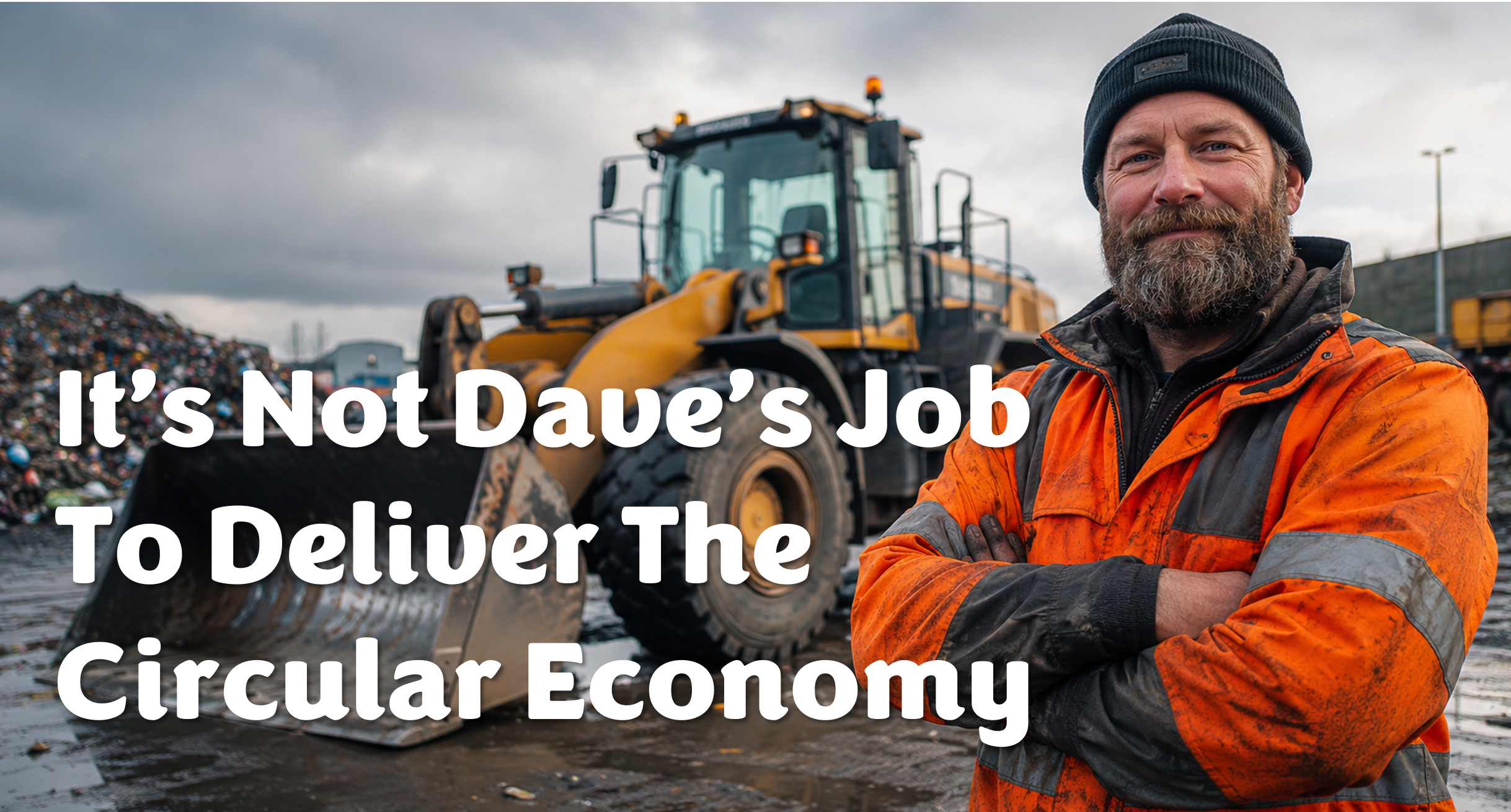
Meet Dave.
Dave works at a waste transfer station. He spends much of his day sitting in a loading shovel, moving waste around, feeding processing plant and loading material into various containers and vehicles. He knows what he’s doing, and he’s been doing it diligently for years.
What Dave probably doesn’t realise is that he also appears to have been given responsibility for delivering the circular economy.
Because somewhere along the way, we seem to have developed the idea that once society has finished designing, manufacturing, buying, using, breaking and throwing things away, it suddenly becomes the waste industry’s responsibility to somehow turn all of it back into useful resources.
And if we can’t, the answer is usually that we need to try harder. Recover more. Recycle more. Invest in better processing. Send less to landfill. Send less to energy from waste. And, increasingly, pay more for whatever remains.
There’s a fairly fundamental problem with this thinking. Because by the time something reaches Dave, most of the decisions that determine what can happen to it have already been made, and the doors of opportunity have closed.
The circular economy starts long before the skip arrives
Long before something becomes waste, somebody decided what it would be made from, how those materials would be combined, how long the product should last, whether it could be repaired and how it would be packaged. Somebody decided whether recycled materials could be used to manufacture it in the first place.
Somebody then bought it, used it and, eventually, decided they didn’t want it anymore.
Only then does it become waste. And only then does it enter the part of the economy occupied by people like Dave.
Yet an extraordinary amount of responsibility for delivering circularity seems to land at this end of the process.
Of course the waste industry has responsibilities. Waste businesses should maximise recovery where it is technically and economically viable. We should invest sensibly in processing and segregation equipment, produce secondary materials of a quality that markets can actually use and find legitimate outlets for them. And we certainly shouldn’t pretend something has been recycled simply because it has disappeared through somebody else’s gate.
But there is a limit to what can be achieved once something has already become waste.
A circular economy cannot be built solely at the point where things are thrown away, because by then many of the decisions that determine whether circularity is even possible have already been made.
Sorting something isn’t the same as recycling it
This is a distinction I think gets lost far too often.
A waste company can spend £5 million on a shiny new processing plant capable of separating a mixed waste stream into a dozen neat little piles.
But that doesn’t create a dozen customers for those materials.
We sometimes talk about recycling as though separating material is the difficult bit. Sometimes it is, but separation is only the beginning. You then need to turn that separated material into something of sufficient and consistent quality to be useful, at an economically viable cost. And, critically, somebody has to want to use it.
Without that final part, we haven’t created a circular economy. We’ve created a dozen piles and, potentially, a dozen headaches.
This matters particularly when we talk about recycling rates, recovery targets and new processing technology. A material doesn’t acquire value simply because we’ve managed to separate it from everything else, and – no matter what the plant salesman will have you believe – installing more sophisticated equipment doesn’t automatically create a market for whatever comes off the end of it.
You can produce the cleanest, most beautifully processed secondary material in Britain. But if nobody wants to buy it, you’ve still got a waste problem.
For a genuinely circular economy to work, recovered materials have to travel back into productive use. Somewhere, somebody has to choose that recovered material instead of virgin material. And that decision frequently sits completely outside the control of the waste company producing it.
A manufacturer may prefer virgin material because it’s cheaper, more readily available or more consistent. A product specification may prevent recycled material being used. Customers may demand characteristics that make secondary materials unsuitable. The manufacturing capacity capable of consuming the recovered material may not exist at sufficient scale. Or the economics of collecting, processing and transporting the material may simply not stack up.
None of those problems can be solved by putting another optical sorter into a waste transfer station.
The waste hierarchy rather gives the game away
The waste hierarchy starts with prevention, followed by reuse, recycling, recovery and finally disposal.
That’s both interesting and important, because the conventional waste industry enters the picture relatively late. By the time we’re being asked to recycle something, the opportunities to prevent it becoming waste, make it last longer or make it easier to reuse have largely passed.
Those decisions sit elsewhere in the economy.
And this is where government has perhaps the most powerful role of all.
Government has more than one lever
Government can influence – or even direct – both product standards and producer responsibility. It can encourage durability and repairability. It can influence the economics of virgin and secondary materials, incentivise or mandate recycled content where that makes sense, and use its own enormous purchasing power to help create demand for recovered materials.
It also has enormous influence over infrastructure, planning, taxation and regulation. In other words, government has the ability to influence both the things that eventually become waste and the markets into which recovered materials need to go.
And yes, government can also make undesirable forms of disposal more expensive.
In fact it’s become extremely good at that last bit.
Landfill Tax has fundamentally changed the economics of waste disposal, and energy from waste gate fees have generally tracked landfill tax. So the financial incentives to move material further up the waste hierarchy are becoming stronger all the time.
Price signals matter. I’m not arguing otherwise.
But a price signal only achieves something useful if the person receiving it has the ability to change the behaviour we’re trying to influence.
If a waste operator is sending material to landfill because recycling it would cost £5 more per tonne, adding another £20 to the cost of disposal may well change the decision. That’s precisely what a price signal is supposed to do.
But what happens when the operator has already recovered everything technically and economically viable? What happens when the remaining material has no realistic recycling outlet? Or when the processing technology exists, but there is no viable market for the resulting output? Or when the infrastructure needed to deal with it simply hasn’t been built?
Making disposal another £30, £40 or £50 per tonne more expensive doesn’t magically make that material recyclable.
It just makes an unsolved problem more expensive.
So what exactly do you want Dave to do?
Let’s go back to our waste transfer station.
A skip arrives containing timber, plasterboard, plastics, packaging, insulation, fines and assorted bits of stuff that somebody, somewhere, once thought would be a good idea to manufacture and sell to the world.
Dave scoops it up and his employer puts it through the best processing system it can economically justify. They recover everything they reasonably can, produce the best secondary materials they can and find customers for the outputs people actually want.
Eventually, though, they’re left with something nobody wants.
So what exactly is Dave supposed to do next?
He can’t prevent the waste from being created in the first place. He can’t redesign the product that created the waste. He can’t create a manufacturer willing to use the material recovered from it. He can’t build the missing infrastructure, and he certainly can’t create national markets for recovered materials simply because policymakers would quite like those markets to exist.
Yet somehow, by the time that material reaches the end of the system, all of those unresolved problems have become his.
Making the final disposal option more expensive doesn’t solve any of them.
The nation’s waste managers deal with the consequences of decisions made throughout the economy. That means the waste industry has a job to do. But so does everyone else.
I absolutely believe the waste industry has a part to play in a more circular economy.
We collect the materials. We understand them. We separate and process them. We invest enormous amounts of money trying to recover value from things that everybody else has finished with.
But the circular economy isn’t a waste management project.
It’s an economic system.
It involves the people designing products, the people manufacturing them, the people specifying materials, the businesses selling them, the consumers buying them, the companies recovering them and, crucially, the manufacturers willing and able to use those recovered materials again.
Government’s job isn’t to do all of those things itself. Its job is to create a consistent and realistic policy and economic environment in which all of those parts of the circle have a realistic chance of connecting.
So perhaps we need to stop asking only why the waste industry isn’t recycling more and start asking why the rest of the economy keeps producing things that nobody can economically recycle.
Dave will do his bit.
But it’s not Dave’s job to deliver the circular economy.
About Gerald Price
Gerald Price is a business change consultant and interim managing director specialising in business turnarounds, operational improvement and commercial performance, especially within the waste and recycling industry.
Having worked with operators across the sector, he regularly writes about leadership, strategy, waste policy and the commercial realities facing UK waste businesses.
More articles and insights can be found at www.gpcp.co.uk and https://www.linkedin.com/in/geraldprice/