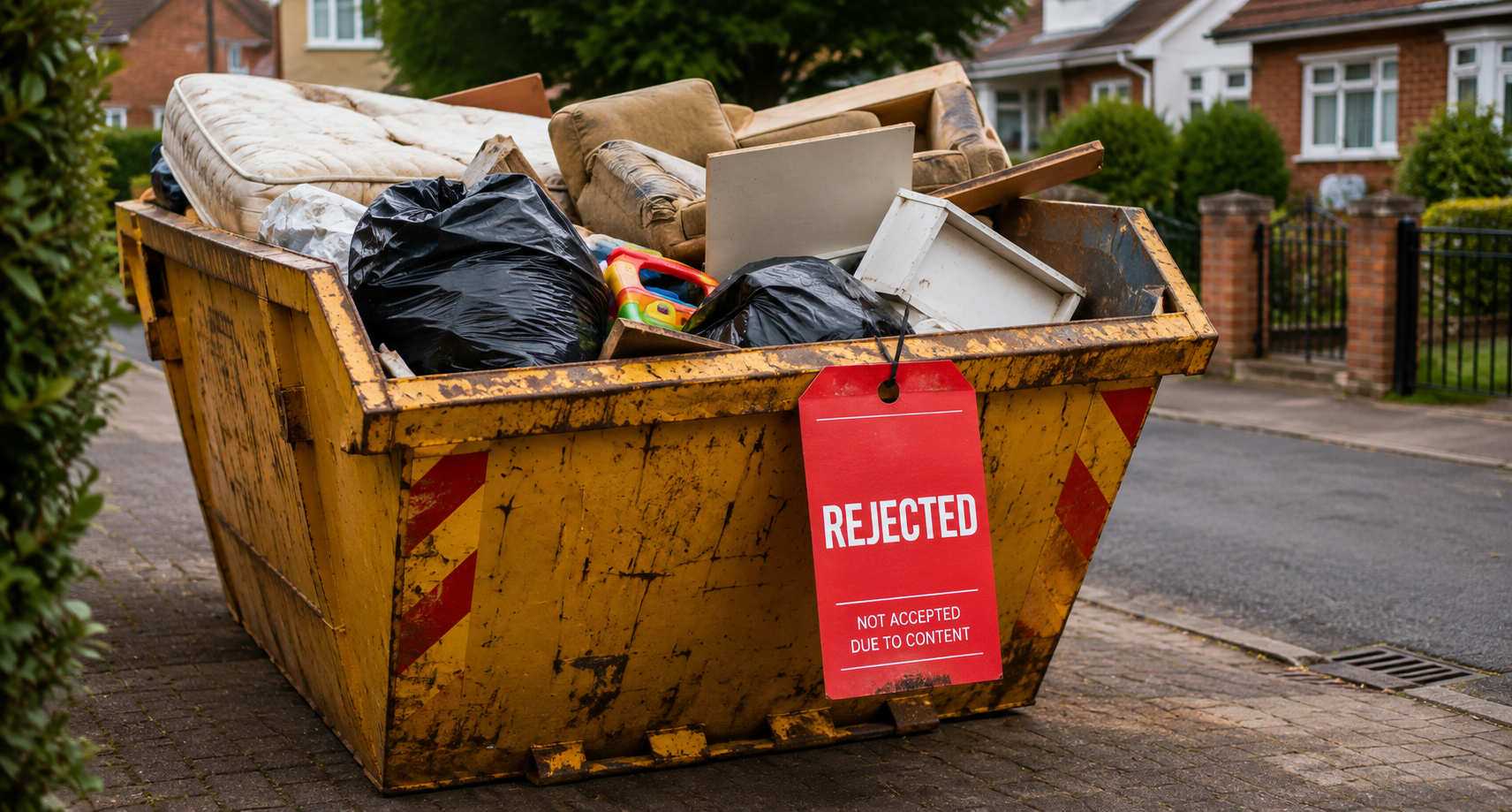
Imagine ringing your local skip company and being told they no longer accept household waste.
Not because they’re fully booked.
Not because they’re closing down.
Simply because they’ve decided they don’t want it.
Five years ago that would have sounded absurd. Household waste has always been part of the bread and butter of the skip hire industry. If you’ve got a garage, a loft or a spare bedroom to clear, somebody has always been willing to drop a skip on your driveway and take the problem away.
I’m no longer convinced that will always be true.
Over the past few months I’ve found myself returning to the same subject time and again: the UK’s disposal infrastructure. While much of the industry’s attention is understandably focused on rising gate fees, I think something much more significant is happening beneath the surface. The issue isn’t simply that disposal has become more expensive. Businesses deal with rising costs every day. The real problem is that disposal has become less certain.
If an Energy from Waste plant increases its gate fee by £20 a tonne, most operators will grumble, sharpen their pencil and work out how to recover the extra cost. That’s what businesses do. What they can’t adapt to quite so easily is arriving at the weighbridge to discover the waste is no longer acceptable, or finding that another landfill has stopped taking material altogether.
Price can be built into a quotation.
Availability can’t.
And I wonder whether that single change is going to alter the way many waste businesses think about their customers.
A Different Way of Looking at Customers
For years we’ve tended to judge customers by fairly obvious commercial measures. How much revenue do they generate? How frequently do they hire skips? Do they pay on time? They’re all sensible questions, but they assume something we’ve largely taken for granted: that once the waste has been collected, there will be somewhere legitimate to take it.
Increasingly, that’s becoming an assumption rather than a certainty.
Imagine two skips standing side by side.
One has come from a small manufacturing business. The other from a domestic house clearance.
On paper they’re remarkably similar. The hire charge is much the same and, at first glance, both customers appear equally attractive.
But are they?
The manufacturing customer is likely to produce fairly predictable waste. Material that’s easier to sort, recycle and direct towards established disposal routes. The domestic clearance is an altogether different proposition. Black bags that should have gone out weeks ago. Mattresses. Sofas. Broken toys. Electrical items. A collection of odds and ends that can quickly become awkward once disposal options begin to narrow.
A few years ago that distinction probably wasn’t especially important.
Today, I think it might be.
Perhaps we’ve spent years judging customers by the revenue they generate, when we should increasingly be asking ourselves a different question.
How confident are we that we can actually dispose of the waste they’re going to produce?
That’s a very different way of looking at a customer portfolio.
It’s also a question I suspect more waste businesses will quietly begin asking over the next few years.
The Unintended Consequences
If that happens, I don’t think the industry will announce some dramatic change of direction. There won’t be press conferences or grand declarations. It’ll happen gradually, one commercial decision at a time.
A company decides not to quote for domestic clearances.
Another quietly removes certain services from its website.
A third concludes that construction customers are simply less troublesome to deal with than mixed household waste.
Each decision will make perfect commercial sense in isolation.
Collectively, though, they’ll begin to reshape the market.
Householders may discover that fewer businesses are willing to accept certain types of waste. Some jobs will inevitably become more expensive. Others may become surprisingly difficult to place at all. Not because waste companies have suddenly become awkward or unhelpful, but because the commercial risk attached to collecting that waste has changed.
And that’s where I think the conversation becomes much bigger than individual businesses.
It’s easy to criticise a waste company for becoming more selective. It’s much harder to ask why so many independent operators might arrive at exactly the same conclusion.
Businesses can’t be expected to provide an uneconomic or operationally impossible public service indefinitely. Their first responsibility is to remain viable. If collecting a particular waste stream increasingly leaves them wondering whether they’ll have anywhere legitimate to take it, changing their customer mix isn’t a moral failure. It’s a rational commercial response.
Which raises a rather uncomfortable question.
If hundreds of independent businesses all begin making the same decision, is the problem really with the businesses?
Or is it with the disposal system they’ve been left to operate within?
For years we’ve judged the success of the waste industry by how efficiently it collects waste.
Perhaps it’s time we started asking a different question.
Has the UK actually built a disposal system that’s capable of dealing with all of the legitimate waste it produces?
Because if the answer is no, “We don’t want your waste” stops sounding like an outrageous thing for a skip company to say.
It starts sounding like the inevitable consequence of the fragmented decisions successive governments have made over the last twenty years.
FAQ
Why are waste companies becoming more selective?
As disposal routes become less predictable and Energy from Waste plants and landfill sites tighten their acceptance criteria, waste companies are increasingly considering whether they can reliably dispose of the waste they collect.
Is the UK’s waste disposal capacity reducing?
Many operators believe disposal resilience has declined in recent years due to landfill closures, changing Energy from Waste acceptance criteria and fewer available disposal outlets for certain waste streams.
Could skip companies stop accepting household waste?
Some operators may increasingly favour customers that generate predictable waste streams if disposal uncertainty continues to grow. This would be a commercial response to changing disposal infrastructure rather than a reluctance to serve household customers.
About Gerald Price
Gerald Price is a business change consultant and interim managing director specialising in business turnarounds, operational improvement and commercial performance, especially within the waste and recycling industry.
Having worked with operators across the sector, he regularly writes about leadership, strategy, waste policy and the commercial realities facing UK waste businesses.
More articles and insights can be found at www.gpcp.co.uk and https://www.linkedin.com/in/geraldprice/