Starting a waste collection or rubbish removal business can look like a relatively straightforward proposition.
Buy a truck or van, register as a waste carrier, find somewhere to tip the waste, advertise your services and start collecting.
And, to be fair, that’s pretty much how a lot of small waste businesses get started.
But there’s an enormous difference between starting a waste business and building one that actually makes money.
I’ve spent years working with waste and recycling businesses, and one of the things I’ve learned is that being busy doesn’t necessarily mean being profitable.
You can have a vehicle out working all day, customers ringing your phone and money coming into your bank account, yet still find yourself earning remarkably little for all that effort.
Before You Buy a Truck, Build a Business Model
Whether you’re considering starting a man-and-van rubbish clearance service, a small skip hire operation or a commercial waste collection business, the first questions shouldn’t be about vehicles.
They should be about customers.
Who are you going to serve? What are they going to pay you to do? Why should they choose you rather than one of the established operators already working in your area?
And, perhaps most importantly, how much money will you actually make from each job?
Because waste collection has some peculiar economics.
You might decide what to charge your customer, but somebody else will often decide how much it costs you to dispose of their waste.
Different materials attract very different disposal charges. The weight and volume of a load can dramatically affect your costs. And the time spent travelling to a disposal facility is time you can’t spend earning money elsewhere.
Get those calculations wrong and you can find yourself working extraordinarily hard for very little reward.
A Free Guide to Starting a Waste Collection Business
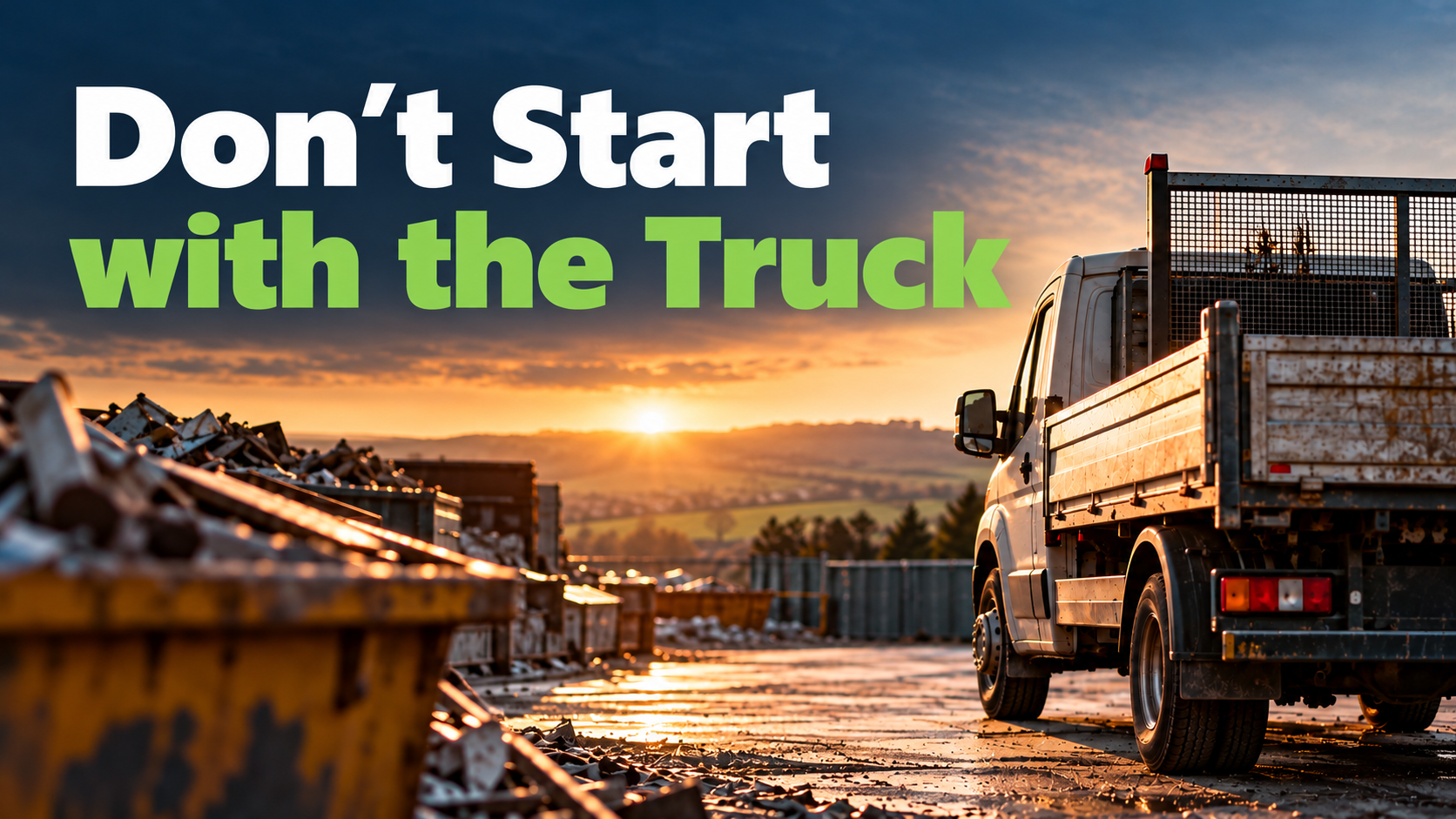
I’ve put together a free, 14-page guide called Don’t Start with the Truck, specifically for people thinking about entering the UK waste and recycling industry.
It covers ten important considerations, including:
- Choosing your customers and identifying what will make your business different.
- Understanding waste disposal outlets, gate fees and material restrictions.
- Calculating the real costs and profitability of individual jobs.
- Working out how many customers and jobs you’ll need.
- Finding customers and understanding the cost of winning their business.
- Understanding regulatory compliance and protecting your working capital.
- Testing whether your proposed business can survive when costs rise or demand falls.
It’s not a technical manual on waste legislation, nor is it a promise that starting a waste business will make you rich.
It’s a practical, commercially focused guide to help you ask the right questions before you commit your savings to a vehicle and discover you’ve bought yourself a very expensive job.
Download Your Free Waste Business Start-Up Guide
If you’re considering starting a rubbish removal, waste clearance or small waste collection business, I’d encourage you to read the guide before spending any significant money.
You might decide that your original idea is a brilliant opportunity.
You might discover that a slightly different approach would make considerably more commercial sense.
Or you might decide not to start at all.
All three could be very good outcomes.
Download your free copy of Don’t Start with the Truck below.
Frequently Asked Questions
How do I start a waste collection business in the UK?
Start by identifying your customers, researching local competition, establishing disposal arrangements and calculating your costs. You’ll also need to understand the registrations, permissions, insurance and waste duty-of-care obligations relevant to your proposed operation.
How much does it cost to start a rubbish removal business?
Start-up costs vary according to your vehicle, insurance, equipment and operating model. The important calculation isn’t simply how much you can afford to spend on a truck, but how much working capital you’ll have left to operate the business.
Is a rubbish removal business profitable?
It can be, but profitability depends on pricing, disposal costs, travel time, labour, vehicle costs and the volume of suitable work available. A busy vehicle doesn’t necessarily mean a profitable business.
About Gerald Price
Gerald Price is a business change consultant and interim managing director specialising in business turnarounds, operational improvement and commercial performance, especially within the waste and recycling industry.
Having worked with operators across the sector, he regularly writes about leadership, strategy, waste policy and the commercial realities facing UK waste businesses.
More articles and insights can be found at www.gpcp.co.uk and https://www.linkedin.com/in/geraldprice/